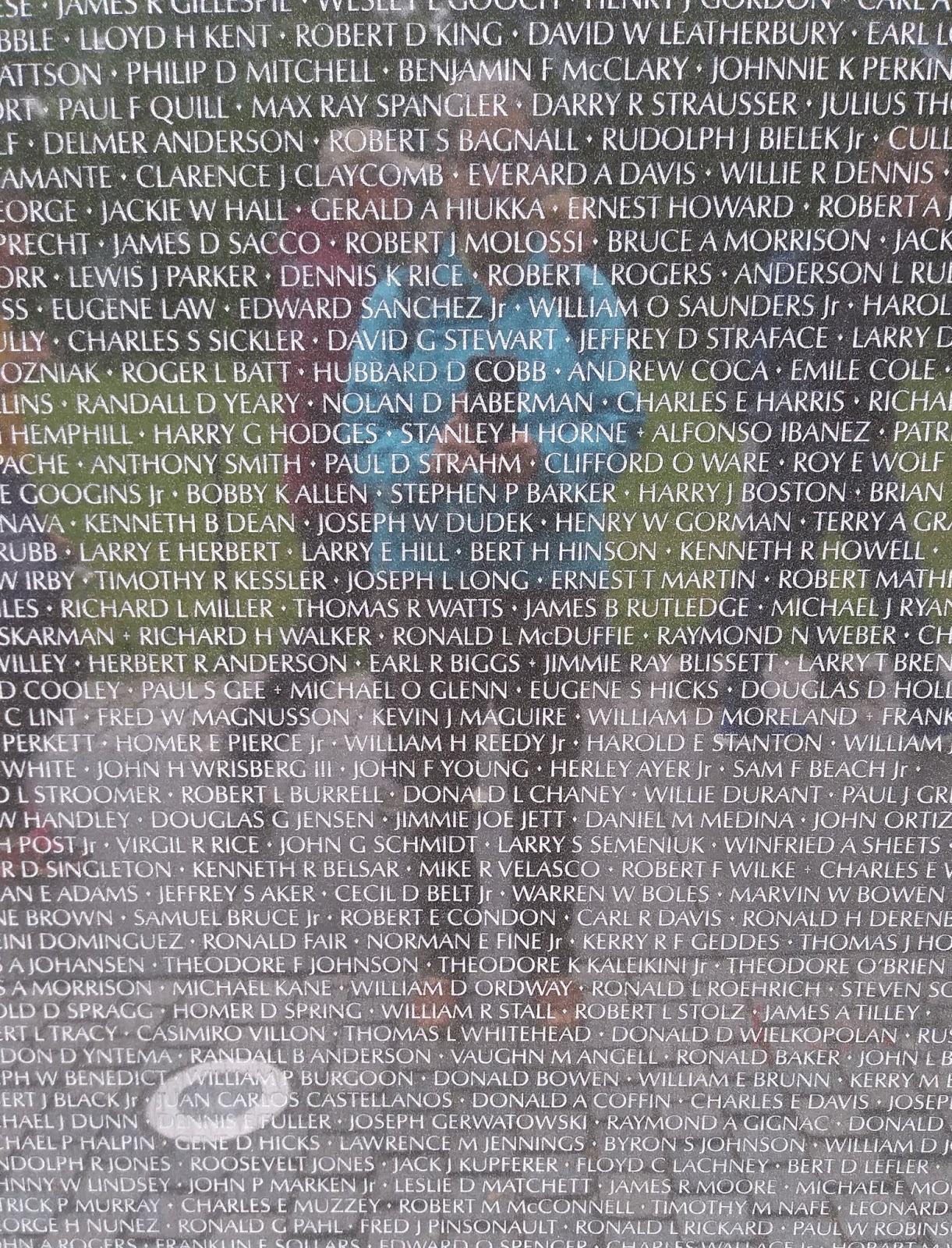
Freedom is not free
or so the slogan goes
yet shiny marble mirrors doubt
lost spirits wrenching souls
Let us now envelop you
Carnage from within
You'll not escape the torment
of the war we'll never win
No patriotic pabulum
can explain our names enshrined
nor reinvent the lies they spewed
nor tell us why we died
With deep respect for all veterans, especially those honored at the Vietnam Veterans Memorial May 2019 _____________________________________________________
En el memorial a los veteranos del Vietnam
La libertad no es gratis
es lo que dicen todos
pero el mármol refleja duda
espíritus perdidos desgarrando almas
Déjanos envolverte ahora
en nuestro masacre interior
No escaparás la intensa agonía
de la guerra que jamás pudimos ganar
Ningún patriotismo insípido
puede explicar nuestros nombres consagrados
ni reinventar las mentiras escupidas
ni decirnos por qué morimos
Con profundo respeto a todos los veteranos, especialmente los que se honran en el Memorial de los veteranos del Vietnam mayo 2019
It's a death camp named after trees: Birkenau, Land of the Birches. 1.2 million people deemed "undesirable" by the Nazis were murdered there and at the adjoining camp, Auschwitz ~ gassed and then cremated. Most were Jews. Their bodies were pillaged after death, with gold fillings yanked out and hair shaved from lifeless heads ~ hair that, after being disinfected and dried, was sent back to Germany to stuff mattresses.
This is a place of unspeakable horror.
Yet the woods throughout the camp are beautiful, with trees dropping their golden leaves when we visited. Beautiful and haunted. If you stop and quiet your mind, you can feel the souls calling out to be remembered.
Say our names. Don't let us be lost. Ivana Hirschmann Franz Pawlak Alfred Ullman Pawel Bak Felix Nussbaum Erich Solomon . . . Don't let us be lost to life. We are woven into your being. You know this, now that you have come to the Land of the Birches.
When I see birches bend to left and right Across the lines of straighter darker trees I like to think some boy's been swinging them.
(Picture on a placard in Birkenau woods, near the remains of Crematorium IV)
I cannot stop thinking of the little girl in the white coat. I want to imagine her swinging on the birches, playing and laughing. Instead, I see her staring intently ~ and perhaps fearfully ~ at the SS soldier who is taking her picture, her big brown eyes revealing a knowledge of suffering far beyond her years. She waits among the birches. She will be murdered before the day is through, along with everyone else in the picture. But they have to wait their turn. By 1944, when this picture was taken, so many people were being killed that they sometimes had to wait in the woods until there was room in the "showers".
Little Girl, Little Girl, you died on that long-ago day. But you are not lost to life. You are now woven into my being. I know this, now that I have visited the Land of the Birches.
Say our names. Don't let us be lost. Herta Sara Ueberall Karel Charvat Alois Handzel Gustaaf Barnstyn Paul Israel Angres Irene Karczewski Jakup Abramczyk Klara Ondicz Leo Lampie Kurt Hauser Armand Aranovitch Szlama Chomont . . .
But swinging doesn't bend them down to stay As ice-storms do. Often you must have seen them Loaded with ice a sunny winter morning After a rain. They click upon themselves As the breeze rises, and turn many-colored As the stir cracks and crazes their enamel. Soon the sun's warmth makes them shed crystal shells Shattering and avalanching on the snow-crust ~ Such heaps of broken glass to sweep away You'd think the inner dome of heaven had fallen. They are dragged to the withered bracken by the load, And they seem not to break; though once they are bowed So low for long, they never right themselves: You may see their trunks arching in the woods Years afterwards, trailing their leaves on the ground Like girls on hand and knees that throw their hair Before them over their heads to dry in the sun.
From Primo Levi's Survival at Auschwitz: The climax came suddenly. The door opened with a crash, and the dark echoed with outlandish orders in that curt, barbaric barking of Germans in command which seems to give vent to a millennial anger. A vast platform appeared before us, lit up by reflectors. A little beyond it, a row of lorries, then everything was silent again. Someone translated: we had to climb down with our luggage and deposit it alongside the train. In a moment the platform was swarming with shadows. But we were afraid to break that silence: everyone busied himself with his luggage, searched for someone else, called to somebody, but timidly, in a whisper. A dozen SS men stood around, legs akimbo, with an indifferent air. At a certain moment they moved among us, and in a subdued tone of voice, with faces of stone, began to interrogate us rapidly, one by one, in bad Italian. They did not interrogate everybody, only a few: 'How old? Healthy or ill?' And on the basis of the reply they pointed in two different directions. Everything was as silent as an aquarium, or as in certain dream sequences. We had expected something more apocalyptic: they seemed simple police agents. It was disconcerting and disarming. Someone dared to ask for his luggage: they replied, 'luggage afterwards'. Someone else did not want to leave his wife; they said, 'together again afterwards'. Many mothers did not want to be separated from their children: they said 'good, good, stay with child'. They behaved with the calm assurance of people doing their normal duty of every day. But Renzo stayed an instant too long to say goodbye to Francesca, his fiancée, and with a single blow they knocked him to the ground. It was their everyday duty. In less than ten minutes all the fit men had been collected together in a group. What happened to the others, to the women, to the children, to the old men, we could establish neither then nor later: the night swallowed them up, purely and simply. Today, however, we know that in that rapid and summary choice each one of us had been judged capable or not of working usefully for the Reich; we know that of our convoy no more than ninety-six men and twenty-nine women entered the respective camps of Monowitz-Buna and Birkenau, and that of all the others, more than five hundred in number, not one was living two days later. This is the reason why three-year-old Emilia died: the historical necessity of killing the children of Jews was self-demonstrative to the Germans. Emilia, daughter of Aldo Levi of Milan, was a curious, ambitious, cheerful, intelligent child; her parents had succeeded in washing her during the journey in the packed car in a tub with tepid water which the degenerate German engineer had allowed them to draw from the engine that was dragging us all to death. Thus in an instant, our women, our parents, our children disappeared. We saw them for a short while as an obscure mass at the other end of the platform; then we saw nothing more. (The original title of Levi's book was "Se questo è un uomo" ~ "If this is a Man".)
And so we sat in meditation on this same platform ~ place of nightmares, where soldiers cruelly sorted people, judging in an instant who was worthy to live and who was not. Since 1996 Zen Peacemakers has organized a retreat to Auschwitz every November. It is intentionally scheduled when the weather will be cold, to remind participants of the realities of the camp. We with our jackets and scarves and hats, bracing ourselves against the icy breeze; they, oh so long ago, with their flimsy "striped pajamas" and ill-fitting shoes, starved and tormented. There is, of course, simply no comparison. But we come to bear witness, in some small way, not only to their suffering, but also to their lives ~ these people who, like all of us, had hopes and dreams and loves. Each day we read their names at the end of our meditation session. The names blended together into a chant, a song of deep lament and love.
Little Girl, Little Girl, I honor the lost potential of your life. You died on that long-ago day, but you are not lost to life. You are now woven into my being. I know this, now that I have visited the Land of the Birches. Say our names. Don't let us be lost. Julius Baar Vilma Heikorn Emma Wagner Kurt Lutz Sabel Max Rack Josef Ciuran Gottlieb Lada Fajga Rajchert Bruna Heller Jan Chmiel Hyman Pach Waleria Nawrocki Freida Hecht Fritz Danziger Leo Israel Nasielski . . .
But I was going to say when Truth broke in With all her matter-of-fact about the ice storm I should prefer to have some boy bend them As he went out and in to fetch the cows ~ Some boy too far from town to learn baseball, Whose only play was what he found himself, Summer or winter, and could play alone. One by one he subdued his father's trees By riding them down over and over again Until he took the stiffness out of them, And not one but hung limp, not one was left For him to conquer.
Play. There was no playing here. The children who were allowed to live were warehoused in a cold, damp barracks. Crowded into bunks, they would often find themselves next to other little ones who were gravely ill or dying. Separated from their parents and cut off from everything they loved, they lived in constant fear. Especially for the older ones, one step out of line could mean a bullet in the head.
Some in our group sang haunting Yiddish and German lullabies. We wept.
Little Girl, Little Girl, these haunting lullabies are for you. You died on that long-ago day, but you are not lost to life. You are now woven into my being. I know this, now that I have visited the Land of the Birches. Say our names. Don't let us be lost. Hersch Daar Bernhard Adrien Hans Israel Sachs Debora Dabrowski Moses Anger Emilia Levi Raphael Pais David Apel Louis Pach Anna Daniel Nathan Kaanis Lily Pachtinger Szmuel Kamisnki Armand Aranovitch Sara Danemans Rudolf Hacker Jeanne Hamm Leib Sagan . . . He learned all there was To learn about not launching out too soon And so not carrying the tree away Clear to the ground. He always kept his poise To the top branches, climbing carefully With the same pains you use to fill a cup Up to the brim, and even above the brim. Then he flung outward, feet first, with a swish, Kicking his way down through the air to the ground. So was I once myself a swinger of birches. And so I dream of going back to be. It's when I'm weary of considerations, And life is too much like a pathless wood Where your face burns and tickles with the cobwebs Broken across it, and one eye is weeping From a twig's having lashed across it open.
The pictures, the pictures ~ ordinary family pictures that prisoners had packed to keep their loved ones close to their hearts. That these pictures exist is a miracle ~ the Nazis had no use for "worthless" items like these, and these inconvenient reminders of their prisoners' humanity were always discarded. But one intrepid soul buried a suitcase filled with these ordinary treasures, and they were found after liberation. They are now displayed in the "sauna" building, where people were subjected to degrading disinfection procedures, showers, and interminable waits while soaking wet, before being sent to their barracks.
We walked among these beautiful faces, so full of life, and cried softly. No words. No words.
Little Girl, Little Girl, you died on that long-ago day, but you are not lost to life. You are now woven into my being.
I know this, now that I have visited the Land of the Birches.
I will never forget you.
Say our names. Don't let us be lost. Pauline Heid Salomon Waas Marianna Glob Samuel Cantor Marjanna Radwan Alexander Lang Helena Nadra Franziska Wagner Julia Labuzek Bronislaw Cias David Glick Ludwik Oman Maria Rebstock Jerzy Salata Helene Backer Kurt Hauser Alois Gacka Markus Israel Landau Joseph Raphael Zofia Sada Leon Tabaka . . . I'd like to get away from earth awhile And then come back to it and begin over. May no fate willfully misunderstand me And half grant what I wish and snatch me away Not to return. Earth's the right place for love: I don't know where it's likely to go better. I'd like to go by climbing a birch tree, And climb black branches up a snow-white trunk Toward heaven, till the tree could bear no more, But dipped its top and set me down again. That would be good both going and coming back. One could do worse than be a swinger of birches.
Robert Frost, "Birches"
The night before we left, we sat for hours in one of the cold, damp barracks. The intense physical and spiritual darkness of that experience was overwhelming.
We live in dark times. I so want to learn how to walk through that darkness ~ to bear witness to it ~ without losing my joy. I want to swing the birches and grieve the pain. That is why I ended up at Birkenau, The Land of the Birches, with the Zen Peacemakers.
What does the Lord ask of you? Only this: that you act justly, love tenderly, and walk humbly with your God. (Micah 6:8)
The Hebrew prophet's wisdom is not unlike the Three Tenets of the Zen Peacemakers:
Not Knowing ~ Giving up all preconceptions; being totally open to a situation, observing and listening deeply.
Bearing Witness ~ Being totally present in a situation, bearing witness to the joy and suffering that we encounter. Not running away, but becoming intimate with whatever is present ~ disease, war, poverty, death.
Loving Actions ~ Actions that naturally arise when one enters a situation in the state of not-knowing and then bears witness to that situation.
Roshi Bernie Glassman, who along with Eve Marko and Andrzej Krajewski founded the Auschwitz Bearing Witness Retreat, told us that when he first got the idea for this retreat, he talked with a rabbi friend of his. The rabbi liked the idea, but offered this advice: "Start with the living. End with the living." And so it was. The retreat ended with a lively Shabbat service and meal. I hold the memory of that, especially the joy of celebrating with so many new soul-friends. But we are all haunted by what we saw. It's an important haunting, and the spirits are now woven in our souls.
Earth's the right place for love. I don't know where it's likely to go better ...
I am grateful beyond belief to the founders: Bernie, Eve, and Andrzej; the organizers, especially Rami and Lilli; Rabbi Shir; and all the facilitators, spirit holders, and fellow companions on this journey. Thank you, thank you, thank you.
recuperando los abedules
Es un campo de concentración que lleva el nombre de árboles. Birkenau: Tierra de los Abedules. 1,2 millones de personas, clasificados como "indeseables" por los Nazis, fueron asesinados allí y en el campo contiguo, Auschwitz ~ gaseados y luego incinerados. La mayoría eran judíos. Sus cuerpos fueron saqueados después de la muerte, con el oro arrancado de los dientes y el cabello afeitado de las cabezas sin vida. Después de desinfectar y secarlo, el pelo fue mandado a Alemania para llenar los colchones. Este es un lugar de brutalidad salvaje. Pero los bosques en el campo son bellos, y las hojas doradas caían cuando visitamos. Bello y embrujado. Si te detienes y calmas tu mente, puedes sentir las almas, llamando para que no se olviden. Digan nuestros nombres. No nos dejen perderse. Ivana Hirschmann Franz Pawlak Alfred Ullman Pawel Bak Felix Nussbaum Erich Solomon . . . No nos dejen perderse de la vida. Estamos tejidos en sus almas. Saben esto, ya que han venido a la Tierra de los Abedules. Cuando veo abedules oscilar a derecha y a izquierda, ante una hilera de árboles más oscuros, me complace pensar que un muchacho los mece.
(Foto del bosque de Birkenau, cerca de las ruinas del Crematorio IV)
No puedo dejar de pensar en la niñita del abrigo blanco. Quiero imaginarla meciendo en los abedules, jugando y riéndose. Pero la veo mirando fijamente ~ y quizá con miedo ~ al soldado SS que toma su foto, sus grandes ojos cafés mostrando una experiencia del sufrimiento más allá de sus años. Espera entre los abedules. La asesinarán ~ junta con todas las personas que se ven en la foto, antes que termine el día. Pero tienen que esperar su turno. Para 1944, la fecha de esta foto, los Nazis mataban a tantos que a veces tenían que esperar en el bosque hasta que fuera lugar en las "duchas".
Ay, Niñita, Niñita, moriste hace tanto tiempo. Pero no estás perdida de la vida. Ahora estás tejida en mi alma. Esto sé, ya que he visitado la Tierra de los Abedules.
Digan nuestros nombres. No nos dejen perderse . . . Herta Sara Ueberall Karel Charvat Alois Handzel Gustaaf Barnstyn Paul Israel Angres Irene Karczewski Jakup Abramczyk Klara Ondicz Leo Lampie Kurt Hauser Armand Aranovitch Szlama Chomont . . .
Pero no es un muchacho quien los deja curvados, sino las tempestades. A menudo hemos visto los árboles cargados de hielo, en claros días invernales, después de un aguacero. Cuando sopla la brisa se les oye crujir se vuelven irisados cuando se resquebraja su esmaltada corteza. Pronto el sol les arrance sus conchas cristalinas, que mezcla con la nieve ~ Esas pilas de conchas esparcidas diríase que son la rota cúpula interior de los cielos. La carga los doblega hacia los mustíos matorrales cercanos, pero nunca se quiebran, aunque jamás podrán enderezarse solos: durante muchos años las ramas de sus troncos curvadas barrerán con sus hojas el suelo, igual que arrodilladas muchachas con los sueltos cabellos hacia atrás y secándose al sol.
De "Si esto es un hombre" de Primo Levi Nos soltaron de repente. Abrieron el portón con estrépito, la oscuridad resonó con órdenes extranjeras, con esos bárbaros ladridos de los alemanes cuando mandan, que parecen dar salida a una rabia secular. Vimos un vasto andén iluminado por reflectores. Un poco más allá, una fila de autocares. Luego, todo quedó de nuevo en silencio. Alguien tradujo: había que bajar con el equipaje, dejarlo junto al tren. En un momento el andén estuvo hormigueante de sombras: pero teníamos miedo de romper el silencio, todos se agitaban en torno a los equipajes, se buscaban, se llamaban unos a otros, pero tímidamente, a media voz. Una decena de SS estaban a un lado, con aire indiferente, con las piernas abiertas. En determinado momento, empezaron a andar entre nosotros y, en voz baja, con rostros de piedra, empezaron a interrogarnos rápidamente, uno a uno, en mal italiano. No interrogaban a todos, sólo a algunos. "¿Cuántos años? ¿Sano o enfermo?" Y según la respuesta nos señalaban dos direcciones diferentes. Todo estaba silencioso como en un acuario, y como en algunas escenas de los sueños. Esperábamos algo más apocalíptico y aparecían unos simples guardias. Era desconcertante y desarmante. Hubo alguien que se atrevió a preguntar por las maletas: contestaron: "maletas después"; otro no quería separarse de su mujer: dijeron "después, otra vez juntos"; muchas madres no querían separarse de sus hijos: dijeron "bien, bien, quedarse con hijo". Siempre con la tranquila seguridad de quien no hace más que su oficio de todos los días; pero Renzo se entretuvo un instante de más al despedirse de Francesca, que era su novia, y con un solo golpe en mitad de la cara lo tumbaron en tierra; era su oficio de cada día. En menos de diez minutos todos los que éramos hombres útiles estuvimos reunidos en un grupo. Lo que fue de los demás, de las mujeres, de los niños, de los viejos, no pudimos saberlo ni entonces ni después: la noche se los tragó, pura y simplemente. Hoy sabemos que con aquella selección rápida y sumaria se había decidido de todos y cada uno de nosotros si podía o no trabajar útilmente para el Reich; sabemos que en los campos de Buna-Monowitz y Birkenau no entraron, de nuestro convoy, más que noventa y siete hombres y veintinueve mujeres y que de todos los demás, que eran más de quinientos, ninguno estaba vivo dos días más tarde. Así murió Emilia, que tenía tres años; ya que a los alemanes les parecía clara la necesidad histórica de mandar a la muerte a los niños de los judíos. Emilia, hija del ingeniero Aldo Levi de Milan, que era una niña curiosa, ambiciosa, alegre e inteligente a la cual, durante el viaje en el vagón atestado, su padre y su madre habían conseguido bañar en un cubo de zinc, en un agua tibia que el degenerado maquinista alemán había consentido en sacar de la locomotora que nos arrastraba a todos a la muerte. Desaparecieron así en un instante, a traición, nuestras mujeres, nuestros padres y madres, nuestros hijos e hijas. Casi nadie pudo despedirse de ellos. Los vimos un poco de tiempo como una masa oscura en el otro extremo del andén, luego ya no vimos nada.
Así nos encontramos sentados en esta misma plataforma ~ sitio de pesadillas, donde los soldados cruelmente clasificaron a la gente, juzgando en un instante, quien merecía vivir y quien no. Desde 1996, cada noviembre, Zen Peacemakers ha organizado un retiro a Auschwitz. Es una fecha intencionada, cuando hace frío, para recordar a los participantes las realidades del campo. Nosotros con nuestras chamarras y bufandas y gorras, protegiéndonos del viento helado; ellos, hace tanto tiempo, con sus piyamas de raya y zapatos que no les quedaban, atormentados y muriendo de hambre. Claro, no hay ninguna comparación. Pero vinimos a ser testigos (Bear Witness), humildemente, a su sufrimiento, pero también a sus vidas ~ estas personas que, como todos nosotros, tenían esperanzas y sueños y amores. Cada día, al final de la sesión de meditación, leíamos sus nombres, nombres que se mezclaban para formar un canto, una canción de profunda lamentación y amor.
Ay, Niñita, Niñita, honro la potencial perdida de tu vida. Moriste hace tanto tiempo, pero no estás perdida de la vida. Ahora estás tejida en mi alma. Esto sé, ya que he visitado la Tierra de los Abedules. Digan nuestros nombres. No nos dejen perderse . . . Julius Baar Vilma Heidorn Emma Wagner Kurt Lutz Sabel Max Rack Josef Ciuran Gottlieb Lada Fajga Rajchert Bruna Heller Jan Chmiel Hyman Pach Waleria Nawrocki Freida Hecht Fritz Danziger Leo Israel Nasielski . . . Más cuando la Verdad se me interpuso en la forma de un hecho como la tempestad, iba a decir que quizás un muchacho, yendo a buscar las vacas, inclinaba los árboles ~ Un muchacho que por vivir lejos del pueblo sólo sabe jugar, en invierno o en verano, a juegos que ha inventado para jugar él solo. Ha domado los árboles de su padre uno a uno pasando por encima de ellos tan a menudo que nada les dejó de su tiesura. A todos doblegó; no dejó ni uno solo sin conquistar.
Jugar. Aquí no se jugaba. Los niños a quienes permitieron vivir estaban detenidos en un barracón frío y húmedo. Muchas veces se encontraban juntos a niños moribundos o gravemente enfermos, en literas abarrotadas. Separados de sus madres y alejados de todo lo que amaban, vivían con miedo constante. Especialmente para los más grandes, un paso en falso podría provocar una bala a la cabeza.
Algunos miembros de nuestro grupo cantaron canciones de cuna en yiddish y alemán. Nos conmovieron hasta las lágrimas.
Ay, Niñita, Niñita, estas inolvidables canciones de cuna son para ti. Moriste hace tanto tiempo, pero no estás perdida de la vida. Ahora estás tejida en mi alma. Esto sé, ya que he visitado la Tierra de los Abedules. Digan nuestros nombres. No nos dejen perderse. Hersch Daar Bernhard Adrien Hans Israel Sachs Debora Dabrowski Moses Anger Emilia Levi Raphael Pais David Apel Louis Pach Anna Daniel Nathan Kaanis Lily Pachtinger Szmuel Kamisnki Armand Aranovitch Sara Danemans Rudolf Hacker Jeanne Hamm Leib Sagan . . . Aprendió la manera de no saltar de un árbol sin haber conseguido doblarlo contra el suelo. Conservó el equilibrio hasta llegar arriba, trepando con cuidado, con la misma destreza que uno emplea al llenar la copa hasta el borde, y aun arriba del borde. Entonces, de un envión, disparaba los pies hacia afuera y saltaba del aire hasta la tierra. Yo fui también, antaño, un columpiador de árboles; muy a menudo sueño en que volveré a serlo, cuando me hallo cansado de mis meditaciones y la vida parece un bosque sin caminos donde, al vagar por él, sentirnos en la cara ardiente el cosquilleo de rotas telarañas, y un ojo lagrimea a causa de una brizna.
Ah, las fotos, las fotos ~ fotos de familia ordinarias que los prisioneros llevaban en sus maletas para mantener cercanos a sus corazones sus seres queridos. Es un milagro que estas fotos existan ~ para los Nazis no tenían valor, y estos recuerdos inconvenientes de la humanidad de sus prisioneros eran siempre tirados. Pero una persona intrépida enterró una maleta llena de estos tesoros ordinarios, y la encontraron después de la liberación. Ahora están en el edificio "sauna", donde la gente fue sujetada a intervenciones humillantes de desinfección, duchas frías, y esperas interminables, parados totalmente mojados, antes de ser mandados a sus barracones.
Caminábamos en medio de estas hermosas caras, tan llenas de vida, y llorábamos. No hay palabras. No hay palabras.
Ay, Niñita, Niñita. Moriste hace tanto tiempo, pero no estás perdida de la vida.
Ahora estás tejida en mi alma.
Esto sé, ya que he visitado la Tierra de los Abedules.
Jamás te olvidaré.
Digan nuestros nombres. No nos dejen perderse. Pauline Heid Salomon Waas Marianna Glob Samuel Cantor Marjanna Radwan Alexander Lang Helena Nadra Franziska Wagner Julia Labuzek Bronislaw Cias David Glick Ludwik Oman Maria Rebstock Jerzy Salata Helene Backer Kurt Hauser Alois Gacka Markus Israel Landau Joseph Raphael Zofia Sada Leon Tabaka . . . Quisiera alejarme de la tierra algún tiempo, para luego volver y empezar otra vez. Que jamás el destino, comprendiéndome mal, me otorgue la mitad de lo que anhelo y me niegue el regreso. Nada hay, para el amor, como la tierra; ignoro si existe mejor sitio. quisiera encaramarme a un abedul, trepar, por las ramas oscuras del blanquecino tronco y subir hacia el cielo, hasta que el abedul, doblándose vencido, me volviese a la tierra. Subir y regresar sería muy hermoso. Pues hay cosas peores en la vida que ser un columpiador de abedules.
Robert Frost, "Abedules"
La penúltima noche del retiro, nos sentamos por horas en uno de los barracones fríos y húmedos. La intensa oscuridad física y espiritual de esa experiencia fue abrumadora.
Vivimos en tiempos oscuros. Quisiera aprender a caminar por esa oscuridad ~ ser testiga a ella ~ sin perder mi alegría. Quisiera columpiar abedules y sentir el duelo. Por eso, fui a Birkenau, La Tierra de los Abedules, con los Zen Peacemakers.
¿Qué es lo que el Señor te pide? Sólo esto: que practiques la justicia, ames con ternura, y camines humildemente con tu Dios. (Miqueas 6:8)
La sabiduría del profeta ebreo se parece a los Tres Principios de los Zen Peacemakers:
No Saber: Dejar todas las ideas preconcebidas y opiniones; estar totalmente abiertos a una situación, observando y escuchando profundamente.
Ser Testigos: Estar totalmente presente en una situación, siendo testigos a la alegría y el sufrimiento que se encuentre. No huirse, hacerse íntimos con lo que esté presente ~ enfermedad, guerra, pobreza, muerte.
Acciónes Compasivas: Acciones que aparecen naturalmente cuando entramos a una situación en el estado de No Saber y Siendo Testigos.
Roshi Bernie Glassman, que con Eve Marko y Andrzej Krajewski, fundó el Auschwitz Bearing Witness Retreat, nos dijo que cuando le llegó la idea de hacer este retiro, habló con un amigo suyo que es rabino. Al rabino, le gustó la idea, pero le dio este consejo: "Comienza con los vivos. Termina con los vivos." Y así fue. El retiro terminó con una celebración muy alegre de Shabbat y con una fiesta. Llevo el recuerdo de eso, especialmente la alegría de celebrar con tantos nuevos amigos del alma. Pero todos estamos poseídos por lo que hemos visto. Es un posesión importante, y los espiritus están ahora tejidos en nuestras almas. Nada hay, para el amor, como la tierra; ignoro si existe mejor sitio . . . Earth's the right place for love. I don't know where it's likely to go better ...
Estoy increíblemente agradecida a los fundadores: Bernie, Eve, and Andrzej; los organizadores, especialmente Rami y Lilli; Rabbi Shir; y todos los facilitadores y compañeros y compañeras en esta jornada. Gracias, gracias, gracias.
It is not weakness to take time to grieve. It is not
intolerance to refuse to “move forward” at this point, to refuse to leave
behind the hateful, mocking, bullying behavior of Donald Trump. It is not weakness to allow ourselves to remember ~ no, more than that
~ to pledge to never forget the mimicking of a disabled reporter, the calls to
ban Muslims, the jeering “get him out of here” when referring to protesters,
the sickening descriptions of women and how he likes to treat them, the wall.
Trump’s words had power, and they have inspired some appalling behavior. We
would never allow our children to behave as he has; yet the electoral college
has elected him as our President. I am grieving right now. That is not being a “sore
loser”. It is being a thoughtful citizen and an introspective human being. We
could use a few more of those.
There are countless calls right now for us to come together
to move forward as a country. I appreciate this, especially the words of Bernie
Sanders. But I refuse to do so prematurely. True work for peace and unity
involves deep reflection on who we are and who we want to become together. In
this time of tweets and soundbites, we speed toward supposed solutions and false reconciliation. Without grief for the civility we are losing, our solutions
will not be grounded or whole.
It is not weakness to take time to grieve.
_____________________
duelo
(Entrada de la iglesia St. Leo en Tacoma, Washington)
No es la debilidad tomarse un tiempo para estar en duelo. No es la intolerancia negarse a "moverse hacia delante" a estas alturas, negarse a dejar atrás el comportamiento odioso, acosador, y burlón de Donald Trump. No es la debilidad permitirnos recordar ~ no, algo más ~ prometer que nunca olvidaremos su imitación de un reportero discapacitado, su llamada a excluir a los musulmanes, el feo "sácalo de aquí" refiriéndose a los manifestantes, las descripciones repugnantes de las mujeres y cómo le gusta tratarlas, el muro.
Las palabras de Trump tenían poder, y han inspirado comportamiento espantoso. Jamás permitiríamos que nuestros hijos se portaran como él; sin embargo, el Colegio Electoral lo ha eligido como nuestro Presidente. Estoy en duelo. Algunos dirían que soy mala perdedora, pero no: estar en duelo en este momento es ser una ciudadana atenta y un ser humano introspectivo.
He oído decir que ahora tenemos que juntarnos, a moverse hacia delante como un país unido. Aprecio el sentimiento, especialmente como lo ha expresado Bernie Sanders. Pero me niego a hacerlo antes de tiempo. El verdadero trabajo por la paz y unidad requiere la reflexión profunda, examinando quiénes somos y quienes queremos ser juntos. En este tiempo de tweets y soundbites/fragmentos de entrevistas, corremos hacia las supuestas soluciones y la falsa reconciliación. Sin el duelo por la urbanidad que estamos perdiendo, nuestras soluciones no tendrán un fundamento y estarán incompletas y falsas.
No es la debilidad tomarse un tiempo para estar en duelo.
Someday, after mastering the winds, the waves, the tides and gravity, we shall harness for God the energies of love, and then, for a second time in the history of the world, man will have discovered fire.
~ Pierre Teilhard de Chardin, S.J.
As the cancer spreads to his bones, he sees them standing on his front lawn most nights. They are soldiers ~ American soldiers ~ and he tells me: "They came for my brother, too, when he was getting close." The visions are not distressing for him because he considers them a normal part of living: "I'm a Pueblo Indian, you know." He's also an Army veteran who was a prisoner of war for 42 months. He survived the Bataan Death March, only to be herded onto one of the infamous "hell ships." During the crossing to Japan, he was packed into an unventilated ship's hold with hundreds of other prisoners, so tightly that no one could lie down. The stench of urine, feces, and vomit was overpowering, and the only water came from a dirty bucket. Many prisoners perished from disease and starvation, but he survived, only to be forced into slave labor in a coal mine. He was also subjected to medical experimentation that would have made the Nazis proud. To this day, he has nightmares and refuses to eat rice or buy a Japanese car. Who am I to challenge this? I just listen and try to get my brain around the sort of cruelty he tells me about.
It's the same sort of feeling I get when I try to imagine the cruelty of the atomic bombs that were dropped on Hiroshima and Nagasaki in August 1945, incinerating hundreds of thousands of people. As I write this, I am wearing a pendant of ginkgo wood, cut from a tree that was charred, but survived, the atomic bombing of Hiroshima. It is a tangible reminder of the atrocity of the atomic bombings, but also of resiliency, that stubborn drive in humanity and in nature to overcome seemingly insurmountable obstacles.
J. Robert Oppenheimer was the physicist who led the Manhattan Project which created the first atomic weapon. It was tested in the New Mexico desert on July 16, 1945. Years later, Oppenheimer said that what came to his mind as he witnessed the test explosion were these words from the sacred Hindu text The Bhagavad Gita: I am become Death, the shatterer of worlds.
Oppenheimer summed up the reaction of many who witnessed the test that summer morning: "We knew the world would not be the same. . . "
*****
It's sometimes called The Blue Marble photo, that striking picture of our planet taken by the Apollo 17 astronauts in late 1972. It was the first clear image of a fully illuminated Earth, and it, too, changed the world, allowing us to savor the beauty, fragility and isolation of our home planet, along with our interconnectedness ~ it's pretty hard to look at the Blue Marble photo without being overwhelmed by the reality that we truly are all in this together. NASA speculates that the photo is the most widely distributed image in human history. Without question, it was a remarkable gift to humanity.
It was also upside-down. The original photo was taken with the South Pole at the top because of the orientation in which the astronauts were traveling at the time. The image was rotated before it was distributed since we are so accustomed to seeing the North Pole at "the top." In reality, of course, the photo wasn't upside-down at all ~ notions of up and down or top and bottom don't have much meaning in space. It's all about perception and what we're used to.
When I taught school, I had two world maps side by side in my classroom: the traditional Mercator Projection and the Peters Projection, which depicts the true size of the continents much more accurately (South America and Africa are suddenly much more prominent). Both projections have serious limitations, but encouraging students to examine them both often brought about a shift in perspective, a challenge to them to let go of pre-conceived ideas. I think if I were teaching today, I'd also have one of these, just to keep the conversations interesting . . .
"Everyone takes the limits of his (sic) own vision for the limits of the world," Schopenhauer said. We all need to be reminded of that ~ and challenged about that ~ on a regular basis.
*****
This is Mandy Patinkin's rendition of You've Got to be Carefully Taught, from the Rodgers and Hammerstein musical South Pacific. It's a powerful lyric, even more so when you consider that it was written in 1949. We've come so far, yet we continue to insanely repeat the patterns that diminish us. We demonized Japanese-Americans during World War II, interring them and stripping them of their civil rights; now we once again find ourselves living in an era marked by fear, this time with the prejudice and intolerance directed toward Muslims. We continue to see war as the solution to myriad problems, even though it doesn't take much of a reading of history to see that war only leads to more war. We do not seem to learn from our mistakes or the atrocities we have caused or lived through.
The definition of insanity is doing the same thing over and over and expecting a different result. Or, as Einstein more eloquently put it: We can't solve problems by using the same kind of thinking we used when we created them. Some would argue that it's impossible to think differently, that war will always be with us. But when we gaze at the Blue Marble picture of our planet ~ our Mother Earth ~ we know in our guts and in our hearts that we must embrace a new way of thinking (and acting) lest we perish as victims of our own arsenals. What is it that we need in order to change our way of thinking?
African tradition calls it Ubuntu: The idea that my humanity is inextricably bound up in yours. Gandhi called it Satyagraha: Non-violent non-cooperation which has the power to win hearts and minds. Martin Luther King, Jr. called it Soul Force: Meeting physical force with firm, but non-violent, resistance. And that radical, itinerant preacher by the name of Jesus: he simply called it Love.
*****
Gather out of star-dust, Earth-dust, Cloud-dust, Storm-dust, And splinters of hail, One handful of dream-dust, Not for sale. Langston Hughes
______________ September 11, 2010 Remembering that the enemy is hatred and extremism, not Islam. Praying for peace.
boca abajo
Algún día , cuando hayamos controlado los vientos, las olas, la marea y la gravedad , tendremos que dominar para Dios las energías del amor. Entonces, por segunda vez en la historia de la humanidad , el hombre habrá descubierto el fuego.
~ Pierre Teilhard de Chardin, S.J.
Mientras el cancer se extiende a sus huesos, los ve casi todas las noches, parados enfrente de la casa. Son soldados ~ soldados estadounidenses ~ y me dice: "Llegaron por mi hermano también cuando se le acercaba la muerte." Las visiones no le molestan porque cree que son una parte normal de la vida: "Soy indio, ya sabes." También es veterano del ejército y fue prisionero de guerra por 42 meses. Sobrevivió la Marcha de la Muerte de Batán, y luego lo metieron en uno de los infames "barcos del infierno." Durante la jornada a Japón, se encontraba con cientos de prisioneros en un barco sin ventilación, tan apretados que ninguno podía pararse. El hedor a orina, mierda, y vómito era insufrible, y el unico agua se encontraba en una cubeta sucia. Muchos de los prisioneros perecieron por la enfermedad y el hambre, pero él sobrevivió, y de ahí lo mandaron a trabajar de esclavo en una mina de carbón. También fue víctima de unos experimentos médicos que hubieran enorgullecido a los Nazis. Todavía tiene pesadillas y se niega a comer arroz o comprar un carro japonés. ¿Quién soy yo para desafiarle acerca de esto? Sólo le escucho y trato de comprender la clase de crueldad que me describe.
Es la misma sensación que tengo cuando trato de imaginar la crueldad de las bombas atómicas que fueron lanzadas a Hiroshima and Nagasaki en agosto de 1945, incinerando a cientos de miles de personas. Mientras escribo esto, llevo un colgante de madera de ginkgo, cortado de un árbol que fue quemado, pero que sobrevivió, el bombardeo atómico de Hiroshima. Es un recuerdo tangible de la atrocidad de los bombardeos atómicos, pero también de la resiliencia, ese instinto tenaz de la humanidad y la naturaleza para superar obstáculos aparentemente imposibles.
J. Robert Oppenheimer fue el físico que dirigió el Proyecto Manhattan que creó la primera bomba atómica. La explotaron, de prueba, en el desierto de Nuevo México el 16 de julio, 1945. Años después, dijo Oppenheimer que mientras observaba la explosión, le llegaron a la mente estas palabras del sagrado texto hindú, el Bhagavad Gita: Me he convertido en la Muerte, el destructor de mundos.
Oppenheimer expresó la reacción de muchos de los que observaron la prueba aquella mañana de verano: "Todos sabíamos que el mundo no volvería a ser igual . . . "
*****
A veces se llama la foto de La Canica Azul, esa fotografía asombrosa de nuestro planeta, tomada por los astronautas de Apollo 17 a fines de 1972. Fue la primera imagen clara de la Tierra totalmente iluminada, y ella también cambió el mundo, dándonos la oportunidad de saborear la hermosura, la fragilidad, y el aislamiento de nuestro planeta, junto con nuestra interconexión ~ es difícil ver la foto de La Canica Azul sin sentirse abrumada por la realidad de que todos estamos entrelazados. NASA dice que es la imagen más distribuida en la historia humana. Sin duda, fue un regalo extraordinario a la humanidad.
También estaba boca abajo. La foto original fue tomada con el Polo Sur encima a causa de la orientación en que viajaban los astronautas. Giraron la imagen antes de distribuirla ya que estamos tan acostumbrados a ver el Polo Norte "encima." En realidad, por supuesto, no estaba boca abajo ~ los conceptos de arriba/abajo o encima/debajo no tienen mucho sentido en el espacio. Todo tiene que ver con la percepción y a qué estamos acostumbrados.
Cuando era maestra, tenía dos mapas mundiales en mi salón: la proyección tradicional de Mercator, y la proyección Peters, que respresenta mejor el tamaño verdadero de los continentes (de repente Sudamérica y África se ven mucho más grandes). Ambas proyecciones tienen serias limitaciones, pero animando a mis estudiantes a examinar ambos mapas causaba, muchas veces, un cambio de perspectiva, un reto para que cuestionaran sus ideas pre-concebidas. Creo que si todavía daba clases, tendría uno de estos también, para que las conversaciones siguieran interesantes . . .
"Cada persona considera que los límites de su propia visión son los límites del mundo," dijo Schopenhauer. Todos necesitamos que nos recuerden de eso ~ y que nos desafíen acerca de eso ~ frecuentemente. ***** (letra en español a continuación)
You've got to be taught Te tienen que enseñar
To hate and fear A odiar y a temer
You've got to be taught Te tienen que enseñar
From year to Year Año tras año
It's got to be drummed Debe ser aporreado
in your dear little ear en tu querida orejita
You've got to be carefully taught Te tienen que enseñar cuidadosamente
You've got to be taught Te tienen que enseñar
To be afraid A tener miedo
Of people whose eyes de la gente cuyos ojos
are oddly made están curiosamente construidos
And people whose skin Y de la gente cuya piel
Is a different shade es de otro color
You've got to be carefully taught Te tienen que enseñar cuidadosamente
You've got to be taught Te tienen que enseñar
Before it's too late Antes que sea demasiado tarde
Before you are 6 or 7 or 8 Antes que cumplas los 6 o 7 o 8
To hate all the people a odiar a toda la gente
your relatives hate que odian tus parientes
You've got to be carefully taught Te tienen que enseñar cuidadosamente
Ésta es la interpretación de Mandy Patinkin de Te Tienen que Enseñar Cuidadosamente, del musical South Pacific de Rodgers and Hammerstein. Es una letra impresionante, aún más cuando se considera que fue escrita en 1949. Hemos avanzado tanto, pero seguimos repitiendo patrones de conducta que nos disminuyen. Demonizamos a los japoneses-americanos durante la Segunda Guerra Mundial, encarcelándolos y quitándoles sus derechos civiles; ahora nos encontramos una vez más en una época dominada por el miedo, esta vez con el perjuicio e intolerancia dirigidas hacia los musulmanes. Seguimos creyendo que la guerra es la solución a muchos problemas, aun sabiendo de la historia que la guerra sólo nos trae más guerra. Pareciera que no aprendemos de nuestros errores, ni de las atrocidades que hemos causado o sobrevivido.
La definición de la locura: haciendo la misma cosa repetidamente y esperando un resultado diferente. O, como lo expresó Einstein, con más elocuencia: No podemos solucionar los problemas empleando la misma manera de pensar que usamos cuando los creamos. Algunas personas dirían que es imposible pensar de otra manera, que siempre tendremos la guerra con nosotros. Pero cuando vemos la foto Canica Azul de nuestro planeta ~ nuestra Madre Tierra ~ sabemos en nuestras entrañas y en nuestros corazones que debemos adoptar una nueva manera de pensar (y actuar) o perecer como víctimas de nuestros propios arsenales. ¿Qué es lo que necesitamos para poder cambiar nuestra manera de pensar?
La tradición africana lo llama Ubuntu: La idea de que mi humanidad está necesariamente entrelazada con la tuya. Gandhi lo llamó Satyagraha: Negarse a cooperar con la injusticia sin violencia, algo que tiene el poder de convertir los corazones y las mentes. Martin Luther King, Jr. lo llamó Fuerza de Alma: Respondiendo a la violencia con una firme resistencia no-violenta. Y ese predicador itinerante y maestro radical, un tal Jesucristo: sencillamente lo llamó Amor.
*****
Recoge del polvo de estrellas Polvo de tierra Polvo de nube Polvo de tormenta Y astillas de granizo Un manojillo de polvo de sueños Que no se vende ~ Langston Hughes
____________________ el 11 de septiembre, 2010 Recordando que el enemigo es el odio y el extremismo, no el Islam. Rezando por la paz.
It was an exquisitely awkward moment. There we were ~ my evil ex-husband and I ~ marching with thousands of people through the streets of Managua on the sixth anniversary of the Sandinista Revolution. (It should be noted that the ex is not at all evil ~ it’s just that the moniker is so catchy ;-) Anyway, the mood was festive and one of the chants went something like this:
Aquí, allá, el Yanqui morirá! (Here, there, the Yankee will die!)
Hmmmm . . .
The ex’s blonde head towered above the crowd, so there was no hiding. There was also no reason to hide: we’d been astonished by the hospitality offered to us as we traveled throughout Nicaragua with our U.S. passports ~ just the two of us ~ at a time when our government was attempting to destabilize theirs. We found ourselves in the middle of the march because we’d struck up a conversation with a young Nicaraguan who invited us. It ended up being one of the highlights of our trip, a graced opportunity to speak with people who were passionate about what they had been able to achieve. They knew we didn’t support our government’s actions, but more importantly, they knew we wanted to listen more than we wanted to talk. We were there to hear their stories.
This was in the midst of the Reagan years ~ you remember, those bad old days of propping up death squads in El Salvador and funding the illustrious “Freedom Fighter” Contras in Nicaragua. The anti-Communist propaganda about the United States’ Central American adventures had been fierce, and there were many Central American refugees in the Río Grande Valley, where we lived, fleeing war in their own countries. Ronald Reagan had been stirring up fear by stating that Managua was only a 48 hour tank ride (!) from Harlingen, Texas. As though anybody would be driving a tank that far, through that many different countries . . . A clever cartoonist had lampooned this absurd assertion of Reagan’s by drawing a “National Hysterical Marker.”
It was around this time that Spanish songwriter Joan Manuel Serrat wrote Algo Personal (Something Personal), a song with a catchy, burlesque melody that belies the underlying seriousness of its satirical message. I didn’t hear it until many years later, but it took me right back to that time ~ and, sadly, to our own time as we pursue misguided policies in Iraq and Afghanistan. It's worth a listen (English translation of the lyrics follows).
Probablemente en su pueblo se les recordará They're probably remembered in their town
como cachorros de buenas personas, as being kind, good people
que hurtaban flores para regalar a su mamá who used to pick flowers to give to their moms
y daban de comer a las palomas. and who fed the birds
Probablemente que todo eso debe ser verdad, Probably all that must be true
aunque es más turbio cómo y de qué manera although it's a little more complicated just exactly how
llegaron esos individuos a ser lo que son these individuals came to be what they are
ni a quién sirven cuando alzan las banderas. and just whom they serve when they wave their flags
Hombres de paja que usan la colonia y el honor Straw men who use colony and honor
para ocultar oscuras intenciones: to hide dark intentions
tienen doble vida, son sicarios del mal. they lead a double life, they're hitmen
Entre esos tipos y yo hay algo personal. Between these guys and me, there's something personal.
Rodeados de protocolo, comitiva y seguridad, Surrounded by protocol, delegations, and security
viajan de incógnito en autos blindados they travel incognito in armored cars
a sembrar calumnias, a mentir con naturalidad, to spread slander, to lie without missing a beat
a colgar en las escuelas su retrato. and to hang their portraits in the schools
Se gastan más de lo que tienen en coleccionar They spend more than they take in
espías, listas negras y arsenales; spies, black lists, and arsenals
resulta bochornoso verles fanfarronear it's embarrassing to see them strutting around
a ver quién es el que la tiene más grande. let's see whose is bigger
Se arman hasta los dientes en el nombre de la paz, They arm themselves to the teeth in the name of peace
juegan con cosas que no tienen repuesto and play around with things that cannot be replaced
y la culpa es del otro si algo les sale mal. it's someone else's fault if something goes wrong
Entre esos tipos y yo hay algo personal. Between these guys and me, there's something personal.
Y como quien en la cosa, nada tiene que perder. And just like someone who has nothing to lose
Pulsan la alarma y rompen las promesas They sound the alarm and break promises
y en nombre de quien no tienen el gusto de conocer and in the name of the one they haven't had the pleasure of meeting
nos ponen la pistola en la cabeza. they put the pistol to our heads.
Se agarran de los pelos, pero para no ensuciar They grab each other by the hair, but so they don't get dirty
van a cagar a casa de otra gente they take a shit in other people's houses
y experimentan nuevos métodos de masacrar, and experiment with new methods of massacre
sofisticados y a la vez convincentes. sophisticated and at the same time convincing
No conocen ni a su padre cuando pierden el control, They don't recognize even their own father when they lose control
ni recuerdan que en el mundo hay niños. nor do they remember that in the world there are children.
Nos niegan a todos el pan y la sal. They withhold bread and salt from everyone
Entre esos tipos y yo hay algo personal. Between these guys and me, there's something personal
Pero, eso sí, los sicarios no pierden ocasión But it's true, the hitmen don't miss an opportunity
de declarar públicamente su empeño to publicly declare their intention
en propiciar un diálogo de franca distensión to foster goodwill dialogue
que les permita hallar un marco previo that would allow them to find a preliminary framework
que garantice unas premisas mínimas that would guarantee minimum support
que faciliten crear los resortes that would enable the creation of the means
que impulsen un punto de partida sólido y capaz to promote a solid and viable starting point
de este a oeste y de sur a norte, from east to west and from south to north
donde establecer las bases de un tratado de amistad on which to base a friendly treaty
que contribuya a poner los cimientos that would help lay the the foundation
de una plataforma donde edificar of a platform on which to build
un hermoso futuro de amor y paz! a beautiful future of love and peace!
Throughout our Nicaraguan trip we were surprised that people spoke so openly with us about their political views. Most were supportive of the Sandinistas, but some were not, and they weren’t shy about telling us so. Sitting in a small restaurant in Estelí, we were amused to witness a Sandinista soldier and another customer happily debating their divergent political views. It’s a memory I will not soon forget.
A number of people couldn’t understand why we chose to travel to Nicaragua at that time. It was dangerous, it was scary, it was COMMUNIST, for God’s sake! Well, we didn’t find it to be any of those things. I now realize that we traveled to Nicaragua in the spirit of Ubuntu. Ubuntu is a South African concept that basically says: My humanity is inextricably bound up inyours. Archbishop Desmond Tutu describes Ubuntu as:
“ . . . the essence of being human. It speaks of the fact that my humanity is caught up and is inextricably bound up in yours. I am human because I belong. It speaks about wholeness, it speaks about compassion. A person with Ubuntu is welcoming, hospitable, warm and generous, willing to share. Such people are open and available to others, willing to be vulnerable, affirming of others, do not feel threatened that others are able and good, for they have a proper self-assurance that comes from knowing that they belong in a greater whole. They know that they are diminished when others are humiliated, diminished when others are oppressed, diminished when others are treated as if they were less than who they are. The quality of Ubuntu gives people resilience, enabling them to survive and emerge still human despite all efforts to dehumanize them."
25 years later, I look back on our Nicaraguan adventure with a smile. It came at a time when I was just beginning to understand Ubuntu, even if I didn't yet have a name for it. Now that I am older and grayer, I call up a bit of Ubuntu energy whenever I feel myself getting holier than thou ~ or just plain arrogant. I remember that I am simply a part of something much greater than I can ever imagine. There is power and freedom ~ and humility ~ in that knowledge.
Ubuntu
Fue un momento sumamente incómodo. Allí estábamos ~ mi ex-esposo malvado y yo ~ caminando con miles de personas en las calles de Managua en el sexto aniversario de la Revolución Sandinista. (Debo señalar que el ex es muy buena gente ~ pero me encanta el apodo ;-) De todos modos, el tono de la marcha era festivo y una de las consignas iba así:
¡Aquí, allá el Yanqui morirá!
Hmmmmm . . .
La cabeza rubia del ex se destacaba sobre la muchedumbre, así que no era posible esconderse. Y no había necesidad de esconderse: nos había asombrado la bienvenida que habíamos recibido mientras viajábamos por Nicaragua con nuestros pasaportes gringos ~ los dos solos ~ en un período cuando nuestro gobierno trataba de desestabalizar el suyo. Nos encontramos en medio de la marcha porque habíamos entrado en una conversación con un joven nicaragüense que nos había invitado a asistir. Fue una de las experiencias más memorables de nuestro viaje, una oportunidad única para hablar con personas apasionadas por lo que habían podido lograr. Sabían que no apoyábamos las acciones de nuestro gobierno, pero más importante, sabían que queríamos escuchar más que queríamos hablar. Estábamos allí para escuchar sus historias.
Todo esto ocurrió durante los años Reagan ~ tú recuerdas, esos malos días de apoyar clandestinamente los escuadrones de la muerte en El Salvador y promover a los ilustres “Combatientes por la Libertad” (Freedom Fighter) Contras en Nicaragua. La propaganda anti-comunista acerca de las aventuras estadounidenses en Centroamérica había sido feroz, y había muchos refugiados centroamericanos en el Valle del Río Grande, donde vivíamos, que huían de las guerras en sus paises. Ronald Reagan había estado provocando el miedo, diciendo que Managua era un viaje de solamente 48 horas en tanque (!) de Harlingen, Texas. Como si alguien estuviera manejando un tanque esa distancia, pasando por tantos países . . . Un caricaturista se burló de esta declaración absurda de Reagan, dibujando un “Marcador Nacional Histérico” (en vez de histórico, claro).
Unos años antes el cantautor español, Joan Manuel Serrat, había escrito Algo Personal, una canción con una melodía pegadiza y burlesque que desmiente la seriedad fundamental de su mensaje satírico. No oí la canción hasta muchos años después, pero me trasladó a aquel tiempo ~ y, tristemente, a nuestro propio tiempo mientras perseguimos nuestra política errada en Irak y Afghanistan. Vale la pena escucharla.
Durante nuestro viaje a Nicaragua, nos sorprendió que la gente hablara tan abiertamente acerca de sus opiniones políticas. La mayoría apoyaban a los Sandinistas, pero algunos no, y no vacilaban en decirnos lo que sentían. Sentados en un pequeño restaurante en Estelí, nos hizo gracia escuchar a un soldado Sandinista y a otro cliente, discutiendo abiertamente, y de buen humor, sobre sus opiniones políticas. Es una memoria que jamás olvidaré.
Muchas personas no podían entender por qué queríamos viajar a Nicaragua en aquel entonces. Era peligroso, era aterrador, por Dios, era COMUNISTA! Pues al llegar allí, descubrimos que no fue nada de eso. Ahora me doy cuenta de que viajamos a Nicaragua en el espíritu de Ubuntu. Ubuntu es un concepto sudafricano que dice: mi humanidad está necesariamente conectada con la tuya. El Arzobispo, Desmond Tutu, lo describe así:
". . . es la esencia de ser humano. Habla de la verdad que mi humanidad está enredada y necesariamente conectada con la tuya. Soy humano porque pertenezco. Habla de la integridad, habla de la compasión. Una persona con Ubuntu es acogedora, cariñosa, y generosa, dispuesta a compartir. Las personas con ubuntu son abiertas y están disponibles para los demás, respaldan a los demás, no se sienten amenazadas cuando otros son capaces y son buenos en algo, porque están seguros de sí mismos, ya que saben que pertenecen a una gran totalidad, que se decrece cuando otras personas son humilladas or menospreciadas, cuando otros son tratados como si fueran menos de lo que son. La calidad de Ubuntu da a la gente la resistencia, permitiendo que sobrevivan y emerjan todavía humanos después de todos los esfuerzos para dehumanizarlos."
25 años después, recuerdo con una sonrisa nuestra aventura nicaragüense. Ocurrió justo cuando empezaba a comprender lo que es Ubuntu, aún sin tener todavía una palabra para el concepto. Ahora que soy más vieja y más canosa, me armo con la energía de Ubuntu siempre que me siento criticona o soberbia. Recuerdo que soy sencillamente una parte de algo mucho más grande de lo que jamás podría imaginar. Con esa sabiduría viene la humildad, el poder y la libertad.