There's something about walking on a path paved with centuries of prayer ~ you never quite know where it might take you.
Getting there is pretty straightforward. You decide that walking the Camino de Santiago ~ an ancient pilgrimage route in Northern Spain ~ is a great idea.You clear your calendar and your head (or so you hope); you start training; you whittle your gear down to what you can carry; you get yourself to St. Jean Pied de Port in Southern France; and you start to walk ~ over the Pyrenees and down into Spain.
One foot in front of the other, mile after mile, day after day.
This is what you came for ~ no surprises here ~ until one day you notice that the spiritual and physical discipline required to keep this rhythm up is cracking you open in ways that you never anticipated. You start to sense that by being here you have entered into a mysterious web of pilgrims, walking through time. You are fully present ~ and that means all of you, even the shadowy parts of yourself that you usually try to deny or stuff. Perhaps they are most important because on this camino, if you are faithful to what is unfolding, you cannot escape them. You realize you might as well surrender and get to know them ~ intimately ~ because you've got plenty of time and they're not going anywhere.
Mile after mile, day after day . . .
Traffic jam in the Pyrenees ~ if you listen carefully, you'll hear cowbells in the distance.
Pyrenees Pigs
Alto de Perdón
Remember what you have seen
because everything forgotten returns to the circling winds . . .
(From a Navajo Chant)
We long to go back there,
or so we like to feel
when it's not too cold.
We long to pay that much attention.
But we've lost the knack;
also there's other music.
All we hear in the wind's plainsong
is the wind.
(From Because We Love Bare Hills and Stunted Trees, by Margaret Atwood)
Path to Cruz de Ferro, where people traditionally leave a rock from their home
Cruz de Ferro
Cruz de Ferro Offerings
¿Quién dijo que todo está perdido?
Yo vengo a ofrecer mi corazón
...No será tan fácil, ya sé qué pasa
No será tan simple como pensaba
Como abrir el pecho y sacar el alma
Una cuchillada de amor . . .
Who said that everything is lost?
I come to offer my heart.
... It won't be so easy, I know how it is
It won't be as simple as I thought
Like opening your chest and pulling out your soul
A gash of love . . .
(From the song, Yo vengo a ofrecer mi corazón, lyrics by Fito Paez)
Memorials are everywhere on the Camino.
Homemade paella at the albergue (hostel) in Hornillos, on the Meseta
Prayer corner in the church in Hontanas
Trail coming out of the mountains, into the city of León
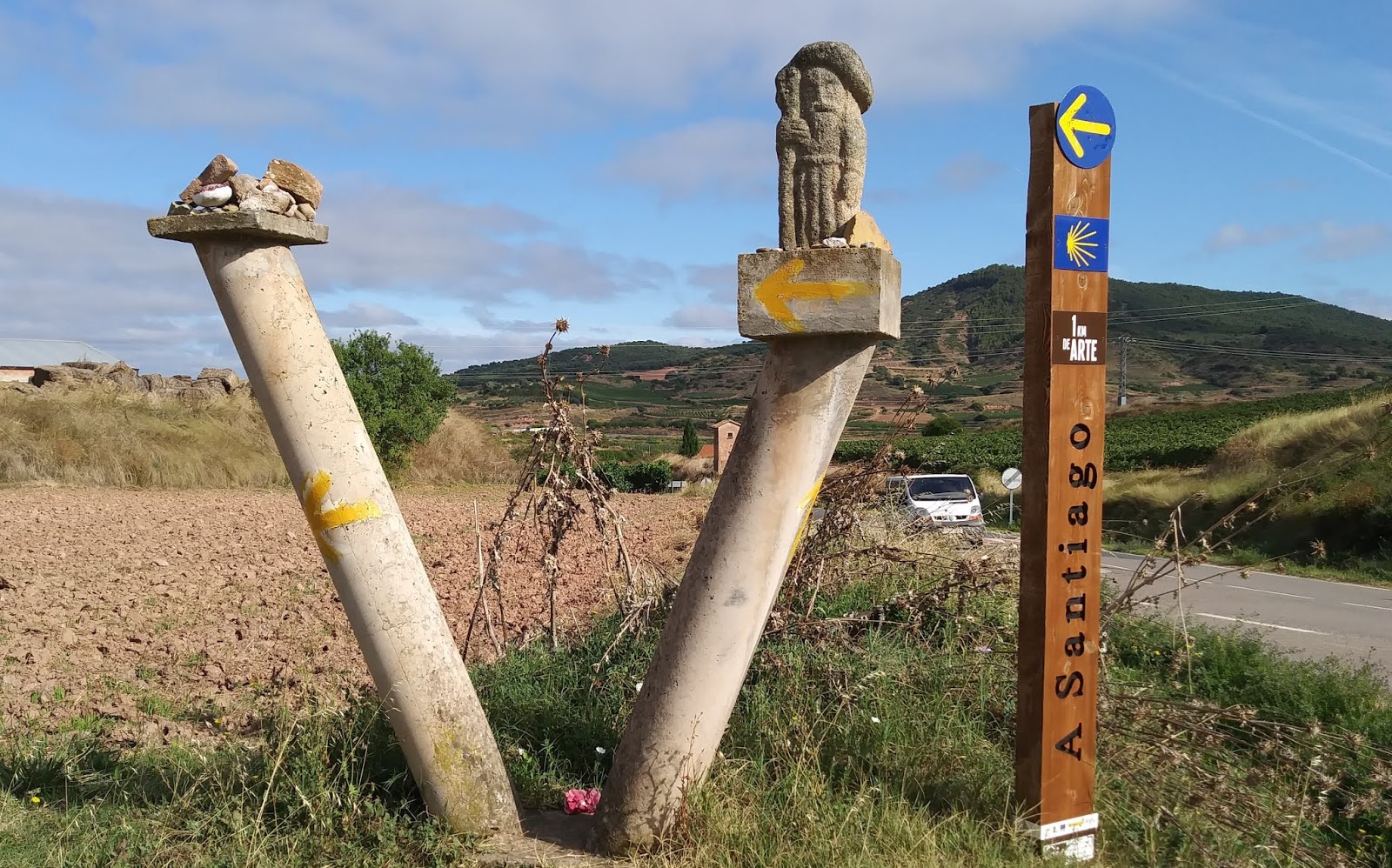
Statue of Santiago the Pilgrim, along with the ever-present blue and yellow arrow and shell markers
A white explorer in Africa, anxious to press ahead with his journey, paid his porters for a series of forced marches. But they, almost within reach of their destination, set down their bundles and refused to budge. No amount of extra payment would convince them otherwise. They said they had to wait for their souls to catch up.
~ Bruce Chatwin
View from O Cebreiro in Galicia
Every day is a god, each day is a god, and holiness holds forth in time. I worship each god, I praise each day splintered down, and wrapped in time like a husk, a husk of many colors spreading, at dawn fast over the mountains split. Annie Dillard
Walking alone for hours (just me and my shadow!); unplugging from news and social media for a psychic detox; loving the evening camaraderie with pilgrims from around the world while recognizing that, for me, the essence of this journey was interior exploration ~ all of this, together, made me more present than I have ever been in my life. For 42 days.
The poetry of that rascally Persian sage, Rumi, evolved and mixed with my own words as I sauntered along the way ~ offering prayers and intentions for my loved ones and forming mantras that I prayed, over and over, until they lodged in my soul.
Startle me back to the truth of who I am.
(Thank you, Light)
which led to
Startle my woundedness into delight.
(Thank you, Shadow)
which led to words that describe, I think, what happened to me on the camino, mile after mile, day after day:
Something opens our wings
Something makes boredom and hurt disappear
Someone fills the cup in front of us
We taste only sacredness
I won't stop praying that one anytime soon.
**************************************
It has been quite a challenge, trying to put together words and pictures that might convey just a bit of what the Camino was for me ~ all 483 miles of it. But now, more than a month later, I realize it might all be as simple as a silly sign I came across on one of the early uphill slogs.
The over-sized exclamation point was alarming at first, but since I have an affinity for American Standards (Thanks, Dad) I quickly recognized the words. In case you didn't, click here:
There may be trouble ahead, oh yes, and trouble right here, most definitely ~ and not just in romance. How well we know this. The challenge, I think, is to hold onto our joy as we walk through the trouble and respond faithfully ~ or, in the words of the poet Jack Gilbert:
We must risk delight. We can do without pleasure,
but not delight. Not enjoyment. We must have
the stubbornness to accept our gladness in the ruthless
there may be trouble ahead/puede haber peligro adelante
Andar en un camino pavimentado con siglos de oración es algo misterioso ~ nunca sabes a donde te va a llevar . . .
Llegar allí es bastante sencillo. Decides que es una idea fantástica hacer el Camino de Santiago ~ una ruta de peregrinaje antigua en España. Haces espacio en tu calendario y tu cabeza (o eso esperas); empiezas a entrenar; planeas lo que vas a llevar en tu mochila; viajas a St. Jean Pied de Port, al sur de Francia; y empiezas a caminar ~ cruzando los Pirineos y bajando a España.
Un pie delante del otro, milla tras milla, día tras día.
Por esto viniste ~ no hay sorpresas aquí ~ hasta que un día empiezas a observar que la disciplina física y espiritual requerida para mantener este ritmo se te parte el alma de una manera que jamás habías anticipado. Empiezas a sentir que has entrado en una red misteriosa de peregrinos, caminando por el tiempo. Estás totalmente presente ~ y eso quiere decir tu ser entero, aun las partes sombrías que sueles negar o esconder. Tal vez sean las partes más importantes porque en este camino, si te quedas fiel a lo que está desarollándose, no puedes escapar de ellas. Te das cuenta que debes rendirte y llegar a conocerlas mejor ~ intimamente ~ porque tú tienes mucho tiempo y ellas no van a ningún lado.
Milla tras milla, día tras día
Embotellamiento en los Pirineos ~ si escuchas cuidadosmente, puedes oír los cencerros.
Cochinos en los Pirineos
Alto de Perdón
Recuerda lo que has visto porque todo lo que se olvida regresa a los vientos circulares
(de un canto navajo)
Queremos regresar allí,
o así nos gusta creer
cuando no hace demasiado frío.
Queremos prestar tanta atención.
Pero hemos perdido la capacidad;
también hay otra música.
Lo único que oimos en la canción del viento
es el viento.
(De Porque amamos los cerros vacíos y árboles cortos, por Margaret Atwood)
We long to go back there,
or so we like to feel
when it's not too cold.
We long to pay that much attention.
But we've lost the knack;
also there's other music.
All we hear in the wind's plainsong
is the wind.
From Because We Love Bare Hills and Stunted Trees, by Margaret Atwood
Sendero a Cruz de Ferro, donde la gente por tracición deja una piedra de su tierra.
Cruz de Ferro
Ofrendas en Cruz de Ferro
¿Quién dijo que todo está perdido?
Yo vengo a ofrecer mi corazón
...No será tan fácil, ya sé qué pasa
No será tan simple como pensaba
Como abrir el pecho y sacar el alma
Una cuchillada de amor . . .
(De la canción, Yo vengo a ofrecer mi corazón, letra de Fito Paez)
Hay memoriales por todo el Camino.
Paella casera en el albergue de Hornillos, en la Meseta
Rincón de oración en la iglesia de Hontanas
Sendero bajando de las montañas hacia la ciudad de León
Estatua de Santiago el Peregrino, junto con los ubicuos marcadores (flechas y conchas) de amarillo y azul
Un explorador blanco en Africa, ansioso por seguir adelante con su jornada, pagó a sus portadores por una serie de marchas forzadas. Pero ellos, casi llegando a su destino, bajaron sus bultos y se negaron a moverse. Ninguna cantidad de dinero les convencería a cambiar de idea. Dijeron que tenían que esperar hasta que sus almas los alcanzaran. ~ Bruce Chatwin
Vista desde O Cebreiro en Galicia
Cada día es un dios, todo día es un dios, y la santidad predica en el tiempo. Alabo a cada dios; elogio cada día astillado, envuelto en el tiempo como una cáscara, una cáscara de muchos colores, extendendiéndose rápido, a la primera luz del alba sobre las montañas partida. Every day is a god, each day is a god, and holiness holds forth in time. I worship each god, I praise each day splintered down, and wrapped in time like a husk, a husk of many colors spreading, at dawn fast over the mountains split. ~ Annie Dillard Caminar sola por muchas horas (con mi sombra!); desenchufándome de las noticias y las redes sociales para hacer un detox psíquica; gozando de la compañía de peregrinos de todo el mundo mientras afirmaba que, para mí, la esencia de esta jornada era la exploración interior ~ todo esto, junto, me hizo más presente que jamás he estado en toda mi vida. Por 42 días, 800 kilometros. Lo poesía de ese pícaro persa, Rumi, transformaba y mezclaba con mis propias palabras mientras caminaba ~ rezando por mis seres queridos y formando mantras que rezaba, repetidamente, hasta que se acomodaran en mi alma: Asómbrame de vuelta a la verdad de quién soy. Startle me back to the truth of who I am. (Gracias, Luz) Asombra (transforma) mis heridas en el deleite. Startle my woundedness into delight. (Gracias, Sombra) que me llevó a las palabras que describen, yo creo, lo que me pasaba en el Camino, milla tras milla, día tras día: Algo nos abre las alas Algo hace que el dolor y el aburrimiento desaparezcan Alguien llena la copa enfrente de nosotros Saboreamos solamente lo sagrado Son palabras que sigo rezando. *************************************** Ha sido un gran desafío, encontrar las palabras y fotos que comuniquen un poquito de lo que ha sido el Camino para mí. Pero ahora, más de un mes después, me doy cuenta de que podría ser tan sencillo como un letrero chistoso que vi mientras subía un cerro en los primeros días.
! Puede haber peligro adelante. Todos los peregrinos presten atención, por favor, que mientras haya luz de luna música amor romance Se les aconseja que enfrenten a la música y bailen El signo de exclamación gigante me alarmó al principio, pero ya que me encantan las canciones viejas (Gracias, Papá), pronto reconocí las palabras. Si tú no, haz clic aquí: https://www.youtube.com/watch?v=O2zQA8WGvl8
Traducción de la letra al español: Puede haber peligro adelante Pero mientras haya luz de luna, música, amor y romance ¡Enfrentemos a la música y bailemos! Antes de que los violinistas se hayan ido Antes que nos pidan que paguemos y mientras aún tengamos oportunidad ¡Enfrentemos a la música y bailemos!
Pronto estaremos sin la luna Tarareando una melodía diferente, y entonces Puede haber lágrimas por derramar Así que mientras haya luz de luna, música, amor y romance ¡Enfrentemos a la música y bailemos!
Puede haber peligro adelante, ah sí, y peligro aquí mismo, definitivamente ~ y no sólo en el romance. Muy bien lo sabemos. El desafío es mantener nuestra alegría mientras navegamos los problemas y el peligro, respondiendo con fieldad ~ o, en las palabras del poeta, Jack Gilbert: Debemos arriesgar el deleite. Podemos vivir sin el placer, pero sin el deleite, no. Sin el gozo, no. Debemos tener la determinación de aceptar nuestra felicidad en el horno despiadado del mundo. (DeUn argumento para la defensa) We must risk delight. We can do without pleasure, but not delight. Not enjoyment. We must have the stubbornness to accept our gladness in the ruthless furnace of the world. (From A Brief for the Defense) Milla tras milla, día tras día. . .
"Buddha's Feet" by Christina Miller. Used with the permission of the artist. www.iconfusion.com
It was the best of times, it was the worst of times. So I decided to take a walk. Caminante, son tus huellas el camino y nada más;
Traveler, it's your footprints that are the path and nothing else; caminante, no hay camino, se hace camino al andar. traveler, there is no path, the path is made by walking. Al andar se hace camino, y al volver la vista atrás se ve la senda que nunca se ha de volver a pisar. By walking, the path is made and looking back the road is seen that will never be traveled again. Caminante, no hay camino sino estelas en la mar. Traveler, there is no path only wakes upon the sea. ~ Antonio Machado, Proverbios y cantares XXIX
Thoreau called it "sauntering" ~ leaving behind the cares of civilization to wander in the woods, there re-discovering the soul of nature and of life. Rooted in Sainte Terre, it seems the word may refer to medieval pilgrims who were walking to their particular "Holy Land". Sauntering is holy walking, soul-strolling, if you will; and while it is wonderful to practice it in the woods, I've come to discover, as I prepare to walk the Camino de Santiago in Spain, that the sauntering spirit can be embraced just about anywhere. When it is, we come to recognize that all of our striving and fretting ~ even for noble causes ~ is futile if it is not coupled with a groundedness that allows us to feel, really feel, our own feet touching this good earth.
It was the age of wisdom, it was the age of foolishness. So I decided to take a walk.
Not to escape. On the contrary, this kind of walking ~ sauntering ~ carries with it the intention to go deeper into Mystery. No easy detours once the path is begun. We saunter to reject that easy way out, where it is so easy to get lost in over-work or its evil twin, indifference. We saunter to remember, as the poet says, that "we must risk delight." (Jack Gilbert, A Brief for the Defense). That phrase has become my mantra during these dark times, with so much cruelty and hatred bubbling up. Risking delight: the delight of looking up for no particular reason and finding two bald eagles circling low in the middle of the city; the delight of a man coming out of our godforsaken immigration prison dancing ~ really ~ dancing with joy because he had just gotten asylum; the delight, intermingled in the sorrow of death, as a life well-lived is celebrated; the delight of the first giggle of a grandbaby; the delight of a crescent moon swinging by Venus on a hot summer's night. Delight: that cosmic caffeine that keeps us awake ~ "woke" ~ when we need to be. We simply cannot do the work that that needs to be done (and oh, there is so much work to be done) without delight. We risk becoming embittered and judgmental, of no use to anyone, without it.
It was the season of Darkness, it was the spring of hope. So I decided to take a walk.
The Catholic Church has seven sacraments (six for women). I would like to propose another: Sauntering ~ the ritual action of discovering, over and over again, the "Holy Land" that is right here, under our feet. I think my good friend, Jesus, who preached peace, love, and creative resistance, would approve.
(This reflection includes phrases from Charles Dickens' A Tale of Two Cities.)
___________________________________
saunter (pasear)
"Buddha's Feet" por Christina Miller. Usado con permiso. www.iconfusion.com Era el mejor de los tiempos, era el peor de los tiempos. Así que decidí dar una vuelta. Caminante, son tus huellas el camino y nada más;
caminante, no hay camino,
se hace camino al andar. Al andar se hace camino, y al volver la vista atrás se ve la senda que nunca se ha de volver a pisar. Caminante, no hay camino sino estelas en la mar. ~ Antonio Machado, Proverbios y cantares XXIX Thoreau lo llamaba "sauntering" ("pasear", pero la verdad esa traducción no comunica el sentido más profundo de la palabra) ~ dejar atrás las preocupaciones de la civilización para vagar por el bosque, allá volver a descubrir el alma de la naturaleza y de la vida. Con el origen de Sainte Terre, parece que la palabra se refiere a los peregrinos medievales que caminaban hacia su "Santa Tierra". Sauntering es caminar de una manera intencional, caminar con el alma; y aunque sea una práctica maravillosa en el bosque, he llegado a descrubrir, mientras me preparo a caminar el Camino de Santiago en España, que el espíritu de sauntering se puede encontrar en cualquier lugar. Y cuando se encuentra, llegamos a reconocer que todas nuestras preocupaciones, nuestros esfuerzos e inquietudes ~ aún cuando sean por una causa noble ~ están en vano si no se juntan con una base sólida que nos permita sentir, realmente sentir, nuestros pies pisando esta buena tierra. Era la edad de la sabiduría, era la edad de la locura. Así que decidi dar una vuelta. No para escaparme. Al contrario, este tipo de caminar ~ sauntering ~ implica la intención de explorar más profundamente el Misterio. Nada de desvíos fáciles después de empezar el camino. Sauntering es rechazar el camino superficial, donde solemos perdernos en el trabajo excesivo o, su gemelo malvado, la indiferencia. Nosotros paseamos (saunter) para recordar, como dice el poeta, que "debemos arriesgar el deleite." (Jack Gilbert, Informe para la defensa). Esa frase se ha convertido en mi mantra durante estos tiempos oscuros, con tanta crueldad y odio que ha subido a la superficie de nuestra sociedad. Arriesgar el deleite: el deleite de mirar hacia arriba, por ninguna razón especial, y ver dos águilas volando en circulos en medio de la ciudad; el deleite de un hombre que salía de nuestra horible prisión de imigración bailando ~ de veras ~ bailando porque había recibido el asilo; el deleite, mezclado con la tristeza de la muerte, de la celebración de una vida bien-vivida; el deleite de la primera sonrisita de una nieta; el deleite de una luna cresciente, brillando con Venus a su lado en una noche clara de verano. Deleite: esa cafeína cósmica que nos mantiene despiertos cuando es importante que estemos alertos. No podemos hacer el trabajo que hay que hacer ( y hay tanto trabajo que hacer) sin el deleite. Corremos el riesgo de volvernos amargos y críticos, perdiéndo la capacidad de ayudar, sin el deleite. Era la edad de la luz, era la edad de las tinieblas. Así que decidí dar una vuelta. La Iglesia Católica tiene siete sacraments (seis para las mujeres). Quisiera proponer otro: Sauntering ~ la acción ritual de descubrir, una y otra vez, que la "Tierra Santa" está aquí, en este momento, debajo de nuestros pies. Creo que mi amigo, Jesucristo ~ él que predicaba la paz, el amor, y la resistencia creativa ~ estaría de acuerdo. (Esta reflexión incluye frases de Charles Dickens, Una historia de dos ciudades.)
Herod ordered the massacre of all the boys two years old
and under in Bethlehem and its environs ...
What was said through Jeremiah
the prophet was then fulfilled:
"A cry was heard at Ramah
sobbing and loud lamentation;
Rachel bewailing her children;
no comfort for her, since they are no more."
Matthew 2: 16, 18
Photo credit: Stella Jaring
We see him every morning
as we walk in silence to Birkenau
place of nightmares and darkness and fear
the very worst of what human beings can do to each other
the little ginger kitten who crosses our path
knows nothing of this
he only knows that this rail car
(preserved so that people will never forget
never forget)
is a marvelous jungle gym
just across the path from his house
jumping and climbing and exploring
on this incredible toy of his
then trotting back to his children
who pet and love and delight in him
who swing and slide and giggle in their yard
just across the path from the rail car
mirroring the faces of the wee ones
carried to their deaths
never forget
never forget
Life is beautiful
life is terrifying
life is mystery
rolled into joy into horror into trust into grief into
a little orange kitten
playing on a death wagon
oh so many years later
to remind us that __________
well, you fill in the blank.
tú llena el espacio
Herodes mandó matar a todos los niños menores de dos años
que había en Belén y sus alrededores ...
Entonces se vio realizado lo que anunció el profeta Jeremías:
En Ramá, se oyeron gritos, grandes sollozos y lamentos. Es Raquel que no quiere consolarse porque llora a sus hijos muertos. Mateo 2: 16, 18
Foto de Stella Jaring
Lo vemos todas las mañanas
mientras caminamos en silencio a Birkenau
lugar de pesadillas y oscuridad y terror
lo peor de lo que los seres humanos pueden hacerse el uno al otro
el gatito anaranjado que cruza nuestro sendero
no sabe nada de esto
sólo sabe que este carro de ferrocarril
(preservado para que la gente jamás olvide
jamás olvide)
es un juego infantil maravilloso
al otro lado del sendero de su casa
saltando y subiendo y explorando
en este increíble juguete
luego corriendo a sus niños
que lo acarician y aman y se deleitan en él
que columpian y resbalan y rien en su patio
justo al otro lado del sendero del carro de ferrocarril
reflejando las caras de los pequeños
llevados a sus muertes
jamás olvide
jamás olvide
La vida es bella
la vida es horrífica
la vida es misterio
envuelto en alegría en horror en confianza en duelo en
It's a death camp named after trees: Birkenau, Land of the Birches. 1.2 million people deemed "undesirable" by the Nazis were murdered there and at the adjoining camp, Auschwitz ~ gassed and then cremated. Most were Jews. Their bodies were pillaged after death, with gold fillings yanked out and hair shaved from lifeless heads ~ hair that, after being disinfected and dried, was sent back to Germany to stuff mattresses.
This is a place of unspeakable horror.
Yet the woods throughout the camp are beautiful, with trees dropping their golden leaves when we visited. Beautiful and haunted. If you stop and quiet your mind, you can feel the souls calling out to be remembered.
Say our names. Don't let us be lost. Ivana Hirschmann Franz Pawlak Alfred Ullman Pawel Bak Felix Nussbaum Erich Solomon . . . Don't let us be lost to life. We are woven into your being. You know this, now that you have come to the Land of the Birches.
When I see birches bend to left and right Across the lines of straighter darker trees I like to think some boy's been swinging them.
(Picture on a placard in Birkenau woods, near the remains of Crematorium IV)
I cannot stop thinking of the little girl in the white coat. I want to imagine her swinging on the birches, playing and laughing. Instead, I see her staring intently ~ and perhaps fearfully ~ at the SS soldier who is taking her picture, her big brown eyes revealing a knowledge of suffering far beyond her years. She waits among the birches. She will be murdered before the day is through, along with everyone else in the picture. But they have to wait their turn. By 1944, when this picture was taken, so many people were being killed that they sometimes had to wait in the woods until there was room in the "showers".
Little Girl, Little Girl, you died on that long-ago day. But you are not lost to life. You are now woven into my being. I know this, now that I have visited the Land of the Birches.
Say our names. Don't let us be lost. Herta Sara Ueberall Karel Charvat Alois Handzel Gustaaf Barnstyn Paul Israel Angres Irene Karczewski Jakup Abramczyk Klara Ondicz Leo Lampie Kurt Hauser Armand Aranovitch Szlama Chomont . . .
But swinging doesn't bend them down to stay As ice-storms do. Often you must have seen them Loaded with ice a sunny winter morning After a rain. They click upon themselves As the breeze rises, and turn many-colored As the stir cracks and crazes their enamel. Soon the sun's warmth makes them shed crystal shells Shattering and avalanching on the snow-crust ~ Such heaps of broken glass to sweep away You'd think the inner dome of heaven had fallen. They are dragged to the withered bracken by the load, And they seem not to break; though once they are bowed So low for long, they never right themselves: You may see their trunks arching in the woods Years afterwards, trailing their leaves on the ground Like girls on hand and knees that throw their hair Before them over their heads to dry in the sun.
From Primo Levi's Survival at Auschwitz: The climax came suddenly. The door opened with a crash, and the dark echoed with outlandish orders in that curt, barbaric barking of Germans in command which seems to give vent to a millennial anger. A vast platform appeared before us, lit up by reflectors. A little beyond it, a row of lorries, then everything was silent again. Someone translated: we had to climb down with our luggage and deposit it alongside the train. In a moment the platform was swarming with shadows. But we were afraid to break that silence: everyone busied himself with his luggage, searched for someone else, called to somebody, but timidly, in a whisper. A dozen SS men stood around, legs akimbo, with an indifferent air. At a certain moment they moved among us, and in a subdued tone of voice, with faces of stone, began to interrogate us rapidly, one by one, in bad Italian. They did not interrogate everybody, only a few: 'How old? Healthy or ill?' And on the basis of the reply they pointed in two different directions. Everything was as silent as an aquarium, or as in certain dream sequences. We had expected something more apocalyptic: they seemed simple police agents. It was disconcerting and disarming. Someone dared to ask for his luggage: they replied, 'luggage afterwards'. Someone else did not want to leave his wife; they said, 'together again afterwards'. Many mothers did not want to be separated from their children: they said 'good, good, stay with child'. They behaved with the calm assurance of people doing their normal duty of every day. But Renzo stayed an instant too long to say goodbye to Francesca, his fiancée, and with a single blow they knocked him to the ground. It was their everyday duty. In less than ten minutes all the fit men had been collected together in a group. What happened to the others, to the women, to the children, to the old men, we could establish neither then nor later: the night swallowed them up, purely and simply. Today, however, we know that in that rapid and summary choice each one of us had been judged capable or not of working usefully for the Reich; we know that of our convoy no more than ninety-six men and twenty-nine women entered the respective camps of Monowitz-Buna and Birkenau, and that of all the others, more than five hundred in number, not one was living two days later. This is the reason why three-year-old Emilia died: the historical necessity of killing the children of Jews was self-demonstrative to the Germans. Emilia, daughter of Aldo Levi of Milan, was a curious, ambitious, cheerful, intelligent child; her parents had succeeded in washing her during the journey in the packed car in a tub with tepid water which the degenerate German engineer had allowed them to draw from the engine that was dragging us all to death. Thus in an instant, our women, our parents, our children disappeared. We saw them for a short while as an obscure mass at the other end of the platform; then we saw nothing more. (The original title of Levi's book was "Se questo è un uomo" ~ "If this is a Man".)
And so we sat in meditation on this same platform ~ place of nightmares, where soldiers cruelly sorted people, judging in an instant who was worthy to live and who was not. Since 1996 Zen Peacemakers has organized a retreat to Auschwitz every November. It is intentionally scheduled when the weather will be cold, to remind participants of the realities of the camp. We with our jackets and scarves and hats, bracing ourselves against the icy breeze; they, oh so long ago, with their flimsy "striped pajamas" and ill-fitting shoes, starved and tormented. There is, of course, simply no comparison. But we come to bear witness, in some small way, not only to their suffering, but also to their lives ~ these people who, like all of us, had hopes and dreams and loves. Each day we read their names at the end of our meditation session. The names blended together into a chant, a song of deep lament and love.
Little Girl, Little Girl, I honor the lost potential of your life. You died on that long-ago day, but you are not lost to life. You are now woven into my being. I know this, now that I have visited the Land of the Birches. Say our names. Don't let us be lost. Julius Baar Vilma Heikorn Emma Wagner Kurt Lutz Sabel Max Rack Josef Ciuran Gottlieb Lada Fajga Rajchert Bruna Heller Jan Chmiel Hyman Pach Waleria Nawrocki Freida Hecht Fritz Danziger Leo Israel Nasielski . . .
But I was going to say when Truth broke in With all her matter-of-fact about the ice storm I should prefer to have some boy bend them As he went out and in to fetch the cows ~ Some boy too far from town to learn baseball, Whose only play was what he found himself, Summer or winter, and could play alone. One by one he subdued his father's trees By riding them down over and over again Until he took the stiffness out of them, And not one but hung limp, not one was left For him to conquer.
Play. There was no playing here. The children who were allowed to live were warehoused in a cold, damp barracks. Crowded into bunks, they would often find themselves next to other little ones who were gravely ill or dying. Separated from their parents and cut off from everything they loved, they lived in constant fear. Especially for the older ones, one step out of line could mean a bullet in the head.
Some in our group sang haunting Yiddish and German lullabies. We wept.
Little Girl, Little Girl, these haunting lullabies are for you. You died on that long-ago day, but you are not lost to life. You are now woven into my being. I know this, now that I have visited the Land of the Birches. Say our names. Don't let us be lost. Hersch Daar Bernhard Adrien Hans Israel Sachs Debora Dabrowski Moses Anger Emilia Levi Raphael Pais David Apel Louis Pach Anna Daniel Nathan Kaanis Lily Pachtinger Szmuel Kamisnki Armand Aranovitch Sara Danemans Rudolf Hacker Jeanne Hamm Leib Sagan . . . He learned all there was To learn about not launching out too soon And so not carrying the tree away Clear to the ground. He always kept his poise To the top branches, climbing carefully With the same pains you use to fill a cup Up to the brim, and even above the brim. Then he flung outward, feet first, with a swish, Kicking his way down through the air to the ground. So was I once myself a swinger of birches. And so I dream of going back to be. It's when I'm weary of considerations, And life is too much like a pathless wood Where your face burns and tickles with the cobwebs Broken across it, and one eye is weeping From a twig's having lashed across it open.
The pictures, the pictures ~ ordinary family pictures that prisoners had packed to keep their loved ones close to their hearts. That these pictures exist is a miracle ~ the Nazis had no use for "worthless" items like these, and these inconvenient reminders of their prisoners' humanity were always discarded. But one intrepid soul buried a suitcase filled with these ordinary treasures, and they were found after liberation. They are now displayed in the "sauna" building, where people were subjected to degrading disinfection procedures, showers, and interminable waits while soaking wet, before being sent to their barracks.
We walked among these beautiful faces, so full of life, and cried softly. No words. No words.
Little Girl, Little Girl, you died on that long-ago day, but you are not lost to life. You are now woven into my being.
I know this, now that I have visited the Land of the Birches.
I will never forget you.
Say our names. Don't let us be lost. Pauline Heid Salomon Waas Marianna Glob Samuel Cantor Marjanna Radwan Alexander Lang Helena Nadra Franziska Wagner Julia Labuzek Bronislaw Cias David Glick Ludwik Oman Maria Rebstock Jerzy Salata Helene Backer Kurt Hauser Alois Gacka Markus Israel Landau Joseph Raphael Zofia Sada Leon Tabaka . . . I'd like to get away from earth awhile And then come back to it and begin over. May no fate willfully misunderstand me And half grant what I wish and snatch me away Not to return. Earth's the right place for love: I don't know where it's likely to go better. I'd like to go by climbing a birch tree, And climb black branches up a snow-white trunk Toward heaven, till the tree could bear no more, But dipped its top and set me down again. That would be good both going and coming back. One could do worse than be a swinger of birches.
Robert Frost, "Birches"
The night before we left, we sat for hours in one of the cold, damp barracks. The intense physical and spiritual darkness of that experience was overwhelming.
We live in dark times. I so want to learn how to walk through that darkness ~ to bear witness to it ~ without losing my joy. I want to swing the birches and grieve the pain. That is why I ended up at Birkenau, The Land of the Birches, with the Zen Peacemakers.
What does the Lord ask of you? Only this: that you act justly, love tenderly, and walk humbly with your God. (Micah 6:8)
The Hebrew prophet's wisdom is not unlike the Three Tenets of the Zen Peacemakers:
Not Knowing ~ Giving up all preconceptions; being totally open to a situation, observing and listening deeply.
Bearing Witness ~ Being totally present in a situation, bearing witness to the joy and suffering that we encounter. Not running away, but becoming intimate with whatever is present ~ disease, war, poverty, death.
Loving Actions ~ Actions that naturally arise when one enters a situation in the state of not-knowing and then bears witness to that situation.
Roshi Bernie Glassman, who along with Eve Marko and Andrzej Krajewski founded the Auschwitz Bearing Witness Retreat, told us that when he first got the idea for this retreat, he talked with a rabbi friend of his. The rabbi liked the idea, but offered this advice: "Start with the living. End with the living." And so it was. The retreat ended with a lively Shabbat service and meal. I hold the memory of that, especially the joy of celebrating with so many new soul-friends. But we are all haunted by what we saw. It's an important haunting, and the spirits are now woven in our souls.
Earth's the right place for love. I don't know where it's likely to go better ...
I am grateful beyond belief to the founders: Bernie, Eve, and Andrzej; the organizers, especially Rami and Lilli; Rabbi Shir; and all the facilitators, spirit holders, and fellow companions on this journey. Thank you, thank you, thank you.
recuperando los abedules
Es un campo de concentración que lleva el nombre de árboles. Birkenau: Tierra de los Abedules. 1,2 millones de personas, clasificados como "indeseables" por los Nazis, fueron asesinados allí y en el campo contiguo, Auschwitz ~ gaseados y luego incinerados. La mayoría eran judíos. Sus cuerpos fueron saqueados después de la muerte, con el oro arrancado de los dientes y el cabello afeitado de las cabezas sin vida. Después de desinfectar y secarlo, el pelo fue mandado a Alemania para llenar los colchones. Este es un lugar de brutalidad salvaje. Pero los bosques en el campo son bellos, y las hojas doradas caían cuando visitamos. Bello y embrujado. Si te detienes y calmas tu mente, puedes sentir las almas, llamando para que no se olviden. Digan nuestros nombres. No nos dejen perderse. Ivana Hirschmann Franz Pawlak Alfred Ullman Pawel Bak Felix Nussbaum Erich Solomon . . . No nos dejen perderse de la vida. Estamos tejidos en sus almas. Saben esto, ya que han venido a la Tierra de los Abedules. Cuando veo abedules oscilar a derecha y a izquierda, ante una hilera de árboles más oscuros, me complace pensar que un muchacho los mece.
(Foto del bosque de Birkenau, cerca de las ruinas del Crematorio IV)
No puedo dejar de pensar en la niñita del abrigo blanco. Quiero imaginarla meciendo en los abedules, jugando y riéndose. Pero la veo mirando fijamente ~ y quizá con miedo ~ al soldado SS que toma su foto, sus grandes ojos cafés mostrando una experiencia del sufrimiento más allá de sus años. Espera entre los abedules. La asesinarán ~ junta con todas las personas que se ven en la foto, antes que termine el día. Pero tienen que esperar su turno. Para 1944, la fecha de esta foto, los Nazis mataban a tantos que a veces tenían que esperar en el bosque hasta que fuera lugar en las "duchas".
Ay, Niñita, Niñita, moriste hace tanto tiempo. Pero no estás perdida de la vida. Ahora estás tejida en mi alma. Esto sé, ya que he visitado la Tierra de los Abedules.
Digan nuestros nombres. No nos dejen perderse . . . Herta Sara Ueberall Karel Charvat Alois Handzel Gustaaf Barnstyn Paul Israel Angres Irene Karczewski Jakup Abramczyk Klara Ondicz Leo Lampie Kurt Hauser Armand Aranovitch Szlama Chomont . . .
Pero no es un muchacho quien los deja curvados, sino las tempestades. A menudo hemos visto los árboles cargados de hielo, en claros días invernales, después de un aguacero. Cuando sopla la brisa se les oye crujir se vuelven irisados cuando se resquebraja su esmaltada corteza. Pronto el sol les arrance sus conchas cristalinas, que mezcla con la nieve ~ Esas pilas de conchas esparcidas diríase que son la rota cúpula interior de los cielos. La carga los doblega hacia los mustíos matorrales cercanos, pero nunca se quiebran, aunque jamás podrán enderezarse solos: durante muchos años las ramas de sus troncos curvadas barrerán con sus hojas el suelo, igual que arrodilladas muchachas con los sueltos cabellos hacia atrás y secándose al sol.
De "Si esto es un hombre" de Primo Levi Nos soltaron de repente. Abrieron el portón con estrépito, la oscuridad resonó con órdenes extranjeras, con esos bárbaros ladridos de los alemanes cuando mandan, que parecen dar salida a una rabia secular. Vimos un vasto andén iluminado por reflectores. Un poco más allá, una fila de autocares. Luego, todo quedó de nuevo en silencio. Alguien tradujo: había que bajar con el equipaje, dejarlo junto al tren. En un momento el andén estuvo hormigueante de sombras: pero teníamos miedo de romper el silencio, todos se agitaban en torno a los equipajes, se buscaban, se llamaban unos a otros, pero tímidamente, a media voz. Una decena de SS estaban a un lado, con aire indiferente, con las piernas abiertas. En determinado momento, empezaron a andar entre nosotros y, en voz baja, con rostros de piedra, empezaron a interrogarnos rápidamente, uno a uno, en mal italiano. No interrogaban a todos, sólo a algunos. "¿Cuántos años? ¿Sano o enfermo?" Y según la respuesta nos señalaban dos direcciones diferentes. Todo estaba silencioso como en un acuario, y como en algunas escenas de los sueños. Esperábamos algo más apocalíptico y aparecían unos simples guardias. Era desconcertante y desarmante. Hubo alguien que se atrevió a preguntar por las maletas: contestaron: "maletas después"; otro no quería separarse de su mujer: dijeron "después, otra vez juntos"; muchas madres no querían separarse de sus hijos: dijeron "bien, bien, quedarse con hijo". Siempre con la tranquila seguridad de quien no hace más que su oficio de todos los días; pero Renzo se entretuvo un instante de más al despedirse de Francesca, que era su novia, y con un solo golpe en mitad de la cara lo tumbaron en tierra; era su oficio de cada día. En menos de diez minutos todos los que éramos hombres útiles estuvimos reunidos en un grupo. Lo que fue de los demás, de las mujeres, de los niños, de los viejos, no pudimos saberlo ni entonces ni después: la noche se los tragó, pura y simplemente. Hoy sabemos que con aquella selección rápida y sumaria se había decidido de todos y cada uno de nosotros si podía o no trabajar útilmente para el Reich; sabemos que en los campos de Buna-Monowitz y Birkenau no entraron, de nuestro convoy, más que noventa y siete hombres y veintinueve mujeres y que de todos los demás, que eran más de quinientos, ninguno estaba vivo dos días más tarde. Así murió Emilia, que tenía tres años; ya que a los alemanes les parecía clara la necesidad histórica de mandar a la muerte a los niños de los judíos. Emilia, hija del ingeniero Aldo Levi de Milan, que era una niña curiosa, ambiciosa, alegre e inteligente a la cual, durante el viaje en el vagón atestado, su padre y su madre habían conseguido bañar en un cubo de zinc, en un agua tibia que el degenerado maquinista alemán había consentido en sacar de la locomotora que nos arrastraba a todos a la muerte. Desaparecieron así en un instante, a traición, nuestras mujeres, nuestros padres y madres, nuestros hijos e hijas. Casi nadie pudo despedirse de ellos. Los vimos un poco de tiempo como una masa oscura en el otro extremo del andén, luego ya no vimos nada.
Así nos encontramos sentados en esta misma plataforma ~ sitio de pesadillas, donde los soldados cruelmente clasificaron a la gente, juzgando en un instante, quien merecía vivir y quien no. Desde 1996, cada noviembre, Zen Peacemakers ha organizado un retiro a Auschwitz. Es una fecha intencionada, cuando hace frío, para recordar a los participantes las realidades del campo. Nosotros con nuestras chamarras y bufandas y gorras, protegiéndonos del viento helado; ellos, hace tanto tiempo, con sus piyamas de raya y zapatos que no les quedaban, atormentados y muriendo de hambre. Claro, no hay ninguna comparación. Pero vinimos a ser testigos (Bear Witness), humildemente, a su sufrimiento, pero también a sus vidas ~ estas personas que, como todos nosotros, tenían esperanzas y sueños y amores. Cada día, al final de la sesión de meditación, leíamos sus nombres, nombres que se mezclaban para formar un canto, una canción de profunda lamentación y amor.
Ay, Niñita, Niñita, honro la potencial perdida de tu vida. Moriste hace tanto tiempo, pero no estás perdida de la vida. Ahora estás tejida en mi alma. Esto sé, ya que he visitado la Tierra de los Abedules. Digan nuestros nombres. No nos dejen perderse . . . Julius Baar Vilma Heidorn Emma Wagner Kurt Lutz Sabel Max Rack Josef Ciuran Gottlieb Lada Fajga Rajchert Bruna Heller Jan Chmiel Hyman Pach Waleria Nawrocki Freida Hecht Fritz Danziger Leo Israel Nasielski . . . Más cuando la Verdad se me interpuso en la forma de un hecho como la tempestad, iba a decir que quizás un muchacho, yendo a buscar las vacas, inclinaba los árboles ~ Un muchacho que por vivir lejos del pueblo sólo sabe jugar, en invierno o en verano, a juegos que ha inventado para jugar él solo. Ha domado los árboles de su padre uno a uno pasando por encima de ellos tan a menudo que nada les dejó de su tiesura. A todos doblegó; no dejó ni uno solo sin conquistar.
Jugar. Aquí no se jugaba. Los niños a quienes permitieron vivir estaban detenidos en un barracón frío y húmedo. Muchas veces se encontraban juntos a niños moribundos o gravemente enfermos, en literas abarrotadas. Separados de sus madres y alejados de todo lo que amaban, vivían con miedo constante. Especialmente para los más grandes, un paso en falso podría provocar una bala a la cabeza.
Algunos miembros de nuestro grupo cantaron canciones de cuna en yiddish y alemán. Nos conmovieron hasta las lágrimas.
Ay, Niñita, Niñita, estas inolvidables canciones de cuna son para ti. Moriste hace tanto tiempo, pero no estás perdida de la vida. Ahora estás tejida en mi alma. Esto sé, ya que he visitado la Tierra de los Abedules. Digan nuestros nombres. No nos dejen perderse. Hersch Daar Bernhard Adrien Hans Israel Sachs Debora Dabrowski Moses Anger Emilia Levi Raphael Pais David Apel Louis Pach Anna Daniel Nathan Kaanis Lily Pachtinger Szmuel Kamisnki Armand Aranovitch Sara Danemans Rudolf Hacker Jeanne Hamm Leib Sagan . . . Aprendió la manera de no saltar de un árbol sin haber conseguido doblarlo contra el suelo. Conservó el equilibrio hasta llegar arriba, trepando con cuidado, con la misma destreza que uno emplea al llenar la copa hasta el borde, y aun arriba del borde. Entonces, de un envión, disparaba los pies hacia afuera y saltaba del aire hasta la tierra. Yo fui también, antaño, un columpiador de árboles; muy a menudo sueño en que volveré a serlo, cuando me hallo cansado de mis meditaciones y la vida parece un bosque sin caminos donde, al vagar por él, sentirnos en la cara ardiente el cosquilleo de rotas telarañas, y un ojo lagrimea a causa de una brizna.
Ah, las fotos, las fotos ~ fotos de familia ordinarias que los prisioneros llevaban en sus maletas para mantener cercanos a sus corazones sus seres queridos. Es un milagro que estas fotos existan ~ para los Nazis no tenían valor, y estos recuerdos inconvenientes de la humanidad de sus prisioneros eran siempre tirados. Pero una persona intrépida enterró una maleta llena de estos tesoros ordinarios, y la encontraron después de la liberación. Ahora están en el edificio "sauna", donde la gente fue sujetada a intervenciones humillantes de desinfección, duchas frías, y esperas interminables, parados totalmente mojados, antes de ser mandados a sus barracones.
Caminábamos en medio de estas hermosas caras, tan llenas de vida, y llorábamos. No hay palabras. No hay palabras.
Ay, Niñita, Niñita. Moriste hace tanto tiempo, pero no estás perdida de la vida.
Ahora estás tejida en mi alma.
Esto sé, ya que he visitado la Tierra de los Abedules.
Jamás te olvidaré.
Digan nuestros nombres. No nos dejen perderse. Pauline Heid Salomon Waas Marianna Glob Samuel Cantor Marjanna Radwan Alexander Lang Helena Nadra Franziska Wagner Julia Labuzek Bronislaw Cias David Glick Ludwik Oman Maria Rebstock Jerzy Salata Helene Backer Kurt Hauser Alois Gacka Markus Israel Landau Joseph Raphael Zofia Sada Leon Tabaka . . . Quisiera alejarme de la tierra algún tiempo, para luego volver y empezar otra vez. Que jamás el destino, comprendiéndome mal, me otorgue la mitad de lo que anhelo y me niegue el regreso. Nada hay, para el amor, como la tierra; ignoro si existe mejor sitio. quisiera encaramarme a un abedul, trepar, por las ramas oscuras del blanquecino tronco y subir hacia el cielo, hasta que el abedul, doblándose vencido, me volviese a la tierra. Subir y regresar sería muy hermoso. Pues hay cosas peores en la vida que ser un columpiador de abedules.
Robert Frost, "Abedules"
La penúltima noche del retiro, nos sentamos por horas en uno de los barracones fríos y húmedos. La intensa oscuridad física y espiritual de esa experiencia fue abrumadora.
Vivimos en tiempos oscuros. Quisiera aprender a caminar por esa oscuridad ~ ser testiga a ella ~ sin perder mi alegría. Quisiera columpiar abedules y sentir el duelo. Por eso, fui a Birkenau, La Tierra de los Abedules, con los Zen Peacemakers.
¿Qué es lo que el Señor te pide? Sólo esto: que practiques la justicia, ames con ternura, y camines humildemente con tu Dios. (Miqueas 6:8)
La sabiduría del profeta ebreo se parece a los Tres Principios de los Zen Peacemakers:
No Saber: Dejar todas las ideas preconcebidas y opiniones; estar totalmente abiertos a una situación, observando y escuchando profundamente.
Ser Testigos: Estar totalmente presente en una situación, siendo testigos a la alegría y el sufrimiento que se encuentre. No huirse, hacerse íntimos con lo que esté presente ~ enfermedad, guerra, pobreza, muerte.
Acciónes Compasivas: Acciones que aparecen naturalmente cuando entramos a una situación en el estado de No Saber y Siendo Testigos.
Roshi Bernie Glassman, que con Eve Marko y Andrzej Krajewski, fundó el Auschwitz Bearing Witness Retreat, nos dijo que cuando le llegó la idea de hacer este retiro, habló con un amigo suyo que es rabino. Al rabino, le gustó la idea, pero le dio este consejo: "Comienza con los vivos. Termina con los vivos." Y así fue. El retiro terminó con una celebración muy alegre de Shabbat y con una fiesta. Llevo el recuerdo de eso, especialmente la alegría de celebrar con tantos nuevos amigos del alma. Pero todos estamos poseídos por lo que hemos visto. Es un posesión importante, y los espiritus están ahora tejidos en nuestras almas. Nada hay, para el amor, como la tierra; ignoro si existe mejor sitio . . . Earth's the right place for love. I don't know where it's likely to go better ...
Estoy increíblemente agradecida a los fundadores: Bernie, Eve, and Andrzej; los organizadores, especialmente Rami y Lilli; Rabbi Shir; y todos los facilitadores y compañeros y compañeras en esta jornada. Gracias, gracias, gracias.